

DumpsTorrent 1Z0-1072-20 Real Exam Question Answers Updated [Jan 09, 2022]
Easily To Pass New Oracle 1Z0-1072-20 Dumps with 240 Questions
Oracle 1Z0-1072-20 Exam Syllabus Topics:
| Topic | Details |
|---|---|
| Topic 1 |
|
| Topic 2 |
|
| Topic 3 |
|
| Topic 4 |
|
| Topic 5 |
|
| Topic 6 |
|
NEW QUESTION 85
When deploying a highly available, Internet-facing, 2-tier web application on Oracle Cloud Infrastructure (OCI), which design option would you use?
- A. Deploy all web servers into multiple Availability Domains and behind a public load balancer, and deploy two single-node OCI database systems across two Availability Domains with Data Guard enabled.
- B. Deploy all web servers into one Availability Domain and behind a public load balancer, and deploy two single-node OCI database systems in the same Availability Domain with Data Guard enabled.
- C. Deploy all web servers into multiple Availability Domains and behind a private load balancer, and deploy two single-node OCI database systems across two Availability Domains with Data Guard enabled.
- D. Deploy all web servers into one Availability Domain, and deploy a single-node OCI database system into a different Availability Domain.
Answer: A
NEW QUESTION 86
Your company is developing a new database application in Oracle Cloud Infrastructure. You need to test application functionality including a hardware failure scenario. Since the application is still in the development phase, you want to minimize infrastructure costs.
Which database service deployment option meets this requirement?
- A. Autonomous Data Warehouse (ADW) system as it provides auto fail over functionality
- B. single node bare metal system
- C. two node real application cluster (RAC) system
- D. two node bare metal system with data guard enabled
Answer: C
NEW QUESTION 87
Which DNS resource record type is used to point a host name to an IPv4 address?
- A. CNAME
- B. ALIAS
- C. AAAA
- D. A
Answer: D
Explanation:
Explanation
References:
https://docs.cloud.oracle.com/iaas/Content/DNS/Reference/supporteddnsresource.htm?tocpath=Services%7CDN
NEW QUESTION 88
Which three load-balancing policies can be used with a back end set? (Choose three.)
- A. IP Hash
- B. CPU Utilization
- C. Weighted Round Robin
- D. Throughput
- E. Least Connections
Answer: A,C,E
Explanation:
Explanation
References:
After you create a load balancer, you can apply policies to control traffic distribution to your backend servers.
The Load Balancing service supports three primary policy types:
Round RobinLeast ConnectionsIP Hash
NEW QUESTION 89
Which two statements about the Oracle File Storage Service (FSS) Security are accurate? (Choose two.)
- A. Security lists can be used as a virtual firewall to prevent an instance from mounting an FSS mount target within a subnet.
- B. FSS leverages UNIX user group and permission checking for file access security.
- C. Data in transit to an FSS mount target is encrypted.
- D. Oracle IAM controls which filesystems are mountable by which instances.
- E. Encryption of file storage in FSS is optional.
Answer: B,C
Explanation:
All data is encrypted at rest. and In-transit encryption provides a way to secure your data between instances and mounted file systems using TLS v. 1.2 (Transport Layer Security) encryption.
File Storage service supports the AUTH_UNIX style of authentication and permission checking for remote NFS client requests.
NEW QUESTION 90
You have successfully configured identity federation between Oracle Cloud Infrastructure (OCI) and Oracle Identity Cloud Services (IDCS). A new project manager wants access to OCI for her team and provides the name of an existing group within IDCS to use when granting access.
How do you configure federation to allow the project team access to OCI resources?
- A. Create a new IAM group in OCI and map it to the existing IDCS group. Create a new policy in IDCS and reference the name of the IAM group.
- B. Create a new Identity and Access Management (IAM) policy in OCI and reference the name of the IDCS group in each policy statement.
- C. Create a new compartment in OCI with the same name as the existing IDCS group. Create an IAM policy that references the new compartment and the name of the IDCS group.
- D. Create a new IAM group in OCI and map it to the existing IDCS group. Create a new IAM policy and reference the name of the IAM group in each policy statement.
Answer: D
Explanation:
Explanation
When working with your IdP, your administrator defines groups and assigns each user to one or more groups according to the type of access the user needs. Oracle Cloud Infrastructure also uses the concept of groups (in conjunction with IAM policies) to define the type of access a user has. As part of setting up the relationship with the IdP, your administrator can map each IdP group to a similarly defined IAM group, so that your company can re-use the IdP group definitions when authorizing user access to Oracle Cloud Infrastructure resources. Here's a screenshot from the mapping process: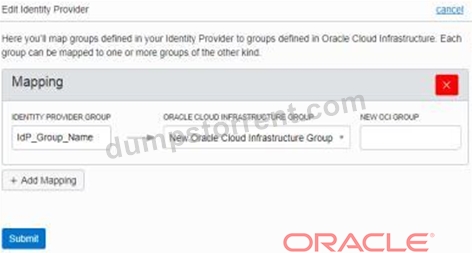
NEW QUESTION 91
You are implementing Oracle Cloud Infrastructure (OCI) FastConnect to access OCI public access points (e.g.
- object storage). You want other Internet traffic from your on-premises environment to use your existing connection with your ISP.
What is the correct way to establish OCI FastConnect to access these OCI public endpoints?
- A. Configure private peering on your FastConnect link. Redistribute BGP routes learned into your existing routing table and advertise a default from your network infrastructure to OCI.
- B. Configure public peering on your FastConnect link. Redistribute BGP routes learned into your existing routing table and advertise a specific route for your network infrastructure to OCI.
- C. Configure public peering on your FastConnect link with a static route that points to OCI object storage service.
- D. Configure private peering on your FastConnect link with a static route that points to OCI object storage service.
Answer: B
Explanation:
Explanation
https://www.oracle.com/a/ocom/docs/connectivity-fast-connect-200.pdf
NEW QUESTION 92
Which two methods are supported for migrating your on-premises Oracle database to an Oracle Autonomous Transaction Processing (ATP) database in Oracle Cloud Infrastructure? (Choose two.)
- A. Transfer the physical database files and re-create the database.
- B. Use database backup and restore.
- C. Use RMAN duplicate.
- D. Use Oracle Data Pump.
- E. Load text files into ATP using SQL Developer.
Answer: A,D
Explanation:
Reference:
https://docs.oracle.com/en/solutions/migrate-to-atp/index.html#GUID-28E5A683-6DC6-4A07- BB1C-55F020D4C1CD
NEW QUESTION 93
Which two statements are true about Oracle Cloud Infrastructure (OCI) DB Systems Data Guard service?
- A. Data guard implementation for Bare Metal shapes requires two DB Systems, one containing the primary database and one containing the standby database.
- B. Data guard configuration on the OCI is limited to a virtual machine only
- C. Data guard implementation requires two DB Systems, one running the primary database on a virtual machine and the standby database running on bare metal.
- D. Both DB systems must use the same VCN, and port 1521 must be open
Answer: A,D
Explanation:
Explanation
An Oracle Data Guard implementation requires two DB systems, one containing the primary database and one containing the standby database. When you enable Oracle Data Guard for a virtual machine DB system database, a new DB system with the standby database is created and associated with the primary database. For a bare metal DB system, the DB system with the database that you want to use as the standby must already exist before you enable Oracle Data Guard.
Requirement details are as follows:
- Both DB systems must be in the same compartment.
- The DB systems must be the same shape type (for example, if the shape of the primary database is a virtual machine, then the shape of the standby database can be any other virtual machine shape).
- If your primary and standby databases are in different regions, then you must peer the virtual cloud networks (VCNs) for each database.
- Configure the security list ingress and egress rules for the subnets of both DB systems in the Oracle Data Guard association to enable TCP traffic to move between the applicable ports. Ensure that the rules you create are stateful (the default).
NEW QUESTION 94
Which two are required to create an IPSec VPN connection? (Choose two.)
- A. name
- B. security list
- C. static route CIDR
- D. compute instance
Answer: B,C
NEW QUESTION 95
You have provisioned an Autonomous Data Warehouse (ADW) database with 16 enabled OCPUs and need to configure the consumer group for your application.
Which two are true when deciding the number of sessions for each application? (Choose two.)
- A. The MEDIUM and LOW consumer group can run up to 16 concurrent SQL statements if HIGH consumer group has 0 SQL statements
- B. The HIGH consumer group can run up to 16 concurrent SQL statements in addition to 32 concurrent SQL statements in MEDIUM and LOW consumer group each
- C. The HIGH consumer group can run up to 16 concurrent SQL statements as long as MEDIUM and LOW consumer groups have 0 SQL statements
- D. The HIGH consumer group can run 3 concurrent SQL statements when MEDIUM consumer group has
0 SQL statements - E. The MEDIUM consumer group can run 20 concurrent SQL statements when HIGH consumer group has
0 SQL statements
Answer: D,E
Explanation:
Explanation
References:
https://docs.oracle.com/en/cloud/paas/autonomous-data-warehouse-cloud/user/connect-predefined.html#GUID-9
NEW QUESTION 96
Which two statements about fault domains are true? (Choose two.)
- A. Each availability domain contains three fault domains
- B. A failed instance in a fault domain is automatically relaunched
- C. A fault domain is selected automatically based on usage data
- D. A fault domain is a grouping of hardware and infrastructure within an availability domain
Answer: A,D
Explanation:
Explanation
References:
A fault domain is a grouping of hardware and infrastructure within an availability domain. Each availability domain contains three fault domains. Fault domains provide anti-affinity: they let you distribute your instances so that the instances are not on the same physical hardware within a single availability domain.
NEW QUESTION 97
Which three actions need to be performed before attempting a data transfer service job?
- A. Create an object bucket to receive the job.
- B. Set up SSH access to a host on OCI to coordinate the transfer job.
- C. Get access to a high-speed internet connection
- D. Data Transfer Service and Storage Service Limits should be checked and raised if required.
- E. Obtain an available host machine which can run the dts utility on-premise with SATA or USB drives attached for the transfer job.
Answer: A,D,E
NEW QUESTION 98
You created a public subnet and an internet gateway in your virtual cloud network (VCN) of Oracle Cloud Infrastructure. The public subnet has an associated route table and security list. However, after creating several compute instances in the public subnet, none can reach the Internet.
Which two are possible reasons for the connectivity issue? (Choose two.)
- A. There is no dynamic routing gateway (DRG) associated with the VCN.
- B. There is no stateful ingress rule in the security list associated with the public subnet.
- C. The route table has no default route for routing traffic to the internet gateway.
- D. There is no stateful egress rule in the security list associated with the public subnet.
- E. A NAT gateway is needed to enable the communication flow to internet.
Answer: B,C
NEW QUESTION 99
Your customer is using an Oracle Cloud Infrastructure (OCI) compartment named Production that hosts several resources such as compute instances, DB Systems and File Systems. Each resource in the Production compartment is tagged.
The customer's security team wants to restrict access to DB Systems to only the authorized group of DBAs.
Which OCI Tagging capability can be used to meet this requirement?
- A. Tag-based Access Control
- B. Tags Defaults with predefined values
- C. Tag Defaults
- D. Cost-Tracking Tags
Answer: A
Explanation:
Explanation/Reference: https://docs.cloud.oracle.com/en-us/iaas/Content/Tagging/Tasks/ managingaccesswithtags.htm#about
NEW QUESTION 100
Your company has decided to move a few applications to Oracle Cloud Infrastructure and you have been asked to design it for Disaster Recovery (DR). One of the items of your design is to deploy the DR at least 300 miles from the home site and minimize the network latency as much as possible.
Based on that, what will be the recommended deployment?
- A. Deploy applications on the same region splitting workloads across Availability Domains.
- B. Deploy applications in two separated VCNs in different regions and use VCN Local Peering
- C. Deploy applications in two separated VCNs in different Availability Domains and use VCN Remote Peering
- D. Deploy applications in different regions and have them connected using VCN Remote Peering
Answer: D
NEW QUESTION 101
......
Latest 1Z0-1072-20 Study Guides 2022 - With Test Engine PDF: https://pass4sure.dumpstorrent.com/1Z0-1072-20-exam-prep.html