

Latest OGBA-101 Exam Dumps The Open Group Exam from Training Expert DumpsTorrent
Pass The Open Group TOGAF Business Architecture Foundation Exam PDF Dumps | Recently Updated 109 Questions
NEW QUESTION # 36
Complete the sentence. The purpose of the Preliminary Phase is to:
- A. Define the enterprise strategy.
- B. Describe the target architecture.
- C. Architect an Enterprise Architecture Capability.
- D. Identify the stakeholders and their requirements.
Answer: C
Explanation:
In the TOGAF ADM, the Preliminary Phase sets up the architecture capability within the organization, establishing architecture governance, defining architecture principles, and setting up necessary processes and tools. This phase is crucial for laying the foundation before formal architecture development begins.
References: TOGAF ADM Preliminary Phase.
The Preliminary Phase is the first phase in the TOGAF Architecture Development Method (ADM). It sets the foundation for successful architecture development within an organization. The primary purpose of this phase is to:
* Establish an Enterprise Architecture practice:This involves defining the organizational structure, processes, and resources needed to support architecture activities.
* Tailor TOGAF to the organization's needs:TOGAF is a flexible framework. The Preliminary Phase allows for adapting the ADM and other TOGAF components to fit the specific context and requirements of the organization.
* Secure senior management commitment:Gaining support from leadership is crucial for the success of any enterprise architecture initiative. This phase helps to ensure that key stakeholders understand and endorse the architecture development process.
* Define the scope and approach:This includes determining the initial scope of the architecture work, identifying relevant architecture domains, and selecting appropriate methods and tools
NEW QUESTION # 37
Which of the following can be used to help define information concepts in an information map?
- A. Stakeholder Map
- B. Organization Map
- C. Value streams
- D. Statement of business goals and drivers
Answer: C
Explanation:
Value streams can be used to help define information concepts in an information map5. A value stream is a representation of a sequence of activities that create an overall result for a customer, stakeholder, or end user5. A value stream can help to identify the information that is required, produced, consumed, or exchanged by each activity in the value stream. An information map can then document and visualize the information concepts and their relationships.
NEW QUESTION # 38
Which of the following can be used to help define information concepts in an information map?
- A. Value streams
- B. Organization Map
- C. Stakeholder Map
- D. Statement of business goals and drivers
Answer: C
Explanation:
* Role of Information Maps in TOGAFInformation maps are used to define and structure the key information concepts necessary for an organization's operations. They organize information in a way thataligns with the organization's business needs and are crucial for creating a robust information architecture.
* Relationship Between Information Maps and Stakeholder MapsIn TOGAF and enterprise architecture practices, stakeholder maps play an essential role in defining information concepts because they identify the various stakeholders involved in or affected by the business operations. Understanding stakeholders and their interactions helps architects determine the types of information that are valuable to each stakeholder group. This understanding aids in structuring the information map to meet the specific needs and requirements of each stakeholder.
As per TOGAF guidance, if an organization already has a stakeholder map, it can serve as a valuable tool for identifying the information concepts required by different stakeholders. This allows architects to tailor the information architecture to align with the interests, roles, and responsibilities of stakeholders, which directly impacts the organization's information needs.
* Why Stakeholder Map is the Correct Answer
* Stakeholder maps provide insights into the information needs of various stakeholders, helping to define information concepts within the information map.
* By referencing a stakeholder map, architects can identify the key information flows, data requirements, and access needs of each stakeholder, ensuring that the information map is comprehensive and aligned with actual usage.
* This alignment with stakeholder needs ensures that the information architecture supports the organization's objectives by delivering relevant information to each party involved.
* Why Other Options are Less Suitable:
* Option B (Value Streams):Value streams focus on the high-level flow of activities that deliver value but do not directly inform the structure of information concepts.
* Option C (Statement of Business Goals and Drivers):While business goals and drivers provide strategic direction, they do not specifically define information concepts in the same way that understanding stakeholder needs does.
* Option D (Organization Map):An organization map helps in understanding roles and responsibilities within the enterprise but does not directly influence the definition of information concepts in the same manner as a stakeholder map.
Conclusion:
The correct answer isA. Stakeholder Mapbecause it directly helps define information concepts in an information map by clarifying the information needs of each stakeholder group.
References:
* TOGAF Standard, Version 9.2, Stakeholder Mapping and Information Mapping Techniques
* TOGAF Business Architecture Guide, sections on Information Maps and Stakeholder Maps
NEW QUESTION # 39
In business capability mapping, when you have documented all of the business capabilities, what should you do next?
- A. Identify the human and computer actors associated with each business capability.
- B. Organize the business capabilities in a logical manner.
- C. Draw up a business value assessment for each of the business capabilities.
- D. Map the business capabilities to stakeholder concerns.
Answer: B
Explanation:
In business capability mapping, once all business capabilities have been documented, the next step is to organize these capabilities logically. This organization helps in understanding how different capabilities interact and align with the business strategy. Here's a detailed explanation based on TOGAF principles:
Business Capability Mapping:
Business capability mapping involves identifying and documenting the capabilities required to execute the business strategy. Capabilities are the building blocks of the business, representing what the business does.
Logical Organization:
Grouping and Categorization: Capabilities should be grouped and categorized logically to reflect their relationships and dependencies. This can be done by aligning capabilities with business functions, processes, or strategic objectives.
Hierarchical Structure: Organizing capabilities into a hierarchical structure helps in visualizing how high-level capabilities decompose into more specific, detailed capabilities. This hierarchical view aids in understanding the complexity and scope of capabilities.
Alignment with Strategy: Logical organization ensures that capabilities are aligned with the business strategy and objectives. It helps in identifying which capabilities are critical for achieving strategic goals and which ones need development or improvement.
TOGAF ADM References:
Phase B: Business Architecture: This phase involves developing the business architecture, including capability mapping. Organizing capabilities logically is a key step in this process, as it helps in creating a coherent and comprehensive business architecture.
Capability Models: TOGAF recommends using capability models to represent the organization's capabilities.
These models should be logically organized to facilitate analysis and planning.
Practical Steps:
Analyze Relationships: Examine the relationships between capabilities to identify dependencies and interactions. This analysis helps in grouping related capabilities together.
Create a Capability Map: Develop a visual representation of the capabilities, organized logically. This map serves as a reference for understanding the business architecture and planning initiatives.
In summary, after documenting all business capabilities, organizing them in a logical manner is essential for creating a coherent and effective business architecture. This logical organization facilitates better analysis, planning, and alignment with business strategy.
NEW QUESTION # 40
What process is used to decompose a set of business capabilities to communicate more detail?
- A. Sorting
- B. Mapping
- C. Leveling
- D. Layering
Answer: C
Explanation:
The process used to decompose a set of business capabilities to communicate more detail is leveling6. Leveling is a technique that can be used to break down a business capability into sub-capabilities at lower levels of granularity6. Leveling can help to provide more clarity and specificity about what a business capability entails and how it supports the business goals and objectives6. Leveling can also help to identify dependencies, gaps, overlaps, or redundancies among business capabilities6.
NEW QUESTION # 41
When developing a Business Architecture, which of the following best describes the approach to take If no Architecture Descriptions exist?
- A. Validate the business principles and update the Statement of Architecture Work.
- B. Information should be gathered, and Business Architecture models developed.
- C. Identify the business goals, business objectives, and drivers for the enterprise
- D. Review the contents of the Architecture Repository.
Answer: B
Explanation:
In the absence of existing Architecture Descriptions, the development of a Business Architecture would begin with the gathering of relevant information about the business. This information can come from strategic documents, business plans, process documents, and stakeholder interviews, among other sources. Once gathered, this information would be used to create Business Architecture models that articulate the business vision, strategy, governance, organization, and key business processes. These models provide a blueprint that captures the essence of the business and guides subsequent architecture work.
NEW QUESTION # 42
Which of the following is a purpose of mapping capabilities to value stream stages?
- A. To describe the business in terms of services provided and consumed.
- B. To classify, group, and align capabilities into categories for a deeper understanding.
- C. To identify and eliminate business capabilities that do not contribute to the business.
- D. To provide a self-contained business description that is independent of the organizational structure.
Answer: C
Explanation:
The purpose of this activity is to identify which business capabilities (out of the total set of capabilities) are critical to delivering stakeholder value, and therefore which ones need to be performed to a sufficient standard of quality to meet stakeholder expectations. It also helps to identify those business capabilities that do not contribute toward any of the core value streams, and which may be eliminated from the business.
The primary purpose of mapping capabilities to value stream stages within the TOGAF framework is to analyze how each capability contributes to delivering value to the customer. This process helps to identify:
* Capabilities essential for value creation:These are the capabilities that directly contribute to the activities within the value stream and are critical for delivering customer value.
* Capabilities with indirect or unclear contributions:These may require further investigation to determine their role in the value stream.
* Non-contributing capabilities:These capabilities do not play a role in the value stream and may be candidates for elimination or optimization to improve efficiency and reduce costs.
NEW QUESTION # 43
Consider the diagram of an architecture development cycle.
Which description matches the phase of the ADM labeled as item 2?
- A. Establishes procedures for managing change to the new architecture
- B. Operates the process of managing architecture requirements
- C. Conducts Implementation planning for the architecture defined in previous phases
- D. Provides architectural oversight for the implementation
Answer: D
Explanation:
The Architecture Development Method (ADM) is the core process of TOGAF which outlines a method for developing and managing the lifecycle of enterprise architecture. Considering the phases of the ADM, the item labeled as '2' in the provided architecture development cycle diagram likely corresponds to the
'Architecture Change Management' phase, which is responsible for providing ongoing architectural oversight and guidance to ensure that the implementation remains aligned with the architecture defined in the previous phases. This includes managing changes to the architecture in a controlled manner as the implementation progresses and ensuring that the architecture continues to meet the business needs.
NEW QUESTION # 44
Which of the following describes how business models are used within the TOGAF standard?
- A. To document the factors impacting the business migration plan.
- B. To help formulate architecture and business principles.
- C. To identify, classify, and mitigate risks to the business.
- D. To tailor the enterprise architecture for the business.
Answer: B
Explanation:
Business models play a significant role in shaping the principles that guide both architecture development and business operations within the TOGAF framework. Here's how:
* Understanding value creation:Business models articulate how an organization creates, delivers, and captures value. This understanding informs the development of architecture principles that support and enable value creation.
* Aligning architecture with business goals:By analyzing the business model, architects can identify the key drivers and priorities of the business. This helps to formulate architecture principles that ensure the architecture aligns with the business goals and strategy.
* Defining desired behaviors:Business models often implicitly or explicitly define desired behaviors and ways of working within an organization. These behaviors can be codified into business principles that guide decision-making and actions across the enterprise.
* Promoting consistency:Using the business model as a foundation for principles ensures consistency between the architecture and the business strategy. This helps to avoid conflicts and ensures that the architecture supports the overall direction of the organization.
NEW QUESTION # 45
Consider the following statements;
1. A whole corporation or a division of a corporation
2. A government agency or a single government department
3. Partnerships and alliances of businesses working together, such as a consortium or supply chain What are those examples of according to the TOGAF Standard?
- A. Architectures Scopes
- B. Enterprises
- C. Organizations
- D. Business Units
Answer: B
Explanation:
According to the TOGAF Standard, an enterprise is defined as any collection of organizations that has a common set of goals and/or a single bottom line1. The examples given in the question are all types of enterprises that can be the subject of enterprise architecture1.
NEW QUESTION # 46
In what TOGAF ADM phase is the organization map linked built out with the detail and relationships to overviews in order to understand the needs of the organization?
- A. Phase B
- B. Preliminary Phase
- C. Phase E
- D. Phase A
Answer: D
Explanation:
Phase A (Architecture Vision) of the TOGAF ADM builds out initial organizational maps to understand high- level organizational needs and link them to architecture goals. This step provides foundational insight that informs subsequent phases, particularly for stakeholder alignment.
References: TOGAF ADM Phase A.
In TOGAF, Phase A (Architecture Vision) is where the organization map is developed in detail and linked to overviews to understand the organizational needs. This phase focuses on:
* Defining the scope of the architecture:This includes identifying the parts of the organization that will be affected by the architecture and the timeframe for the architecture development.
* Identifying stakeholders and their concerns:Understanding the needs and expectations of different stakeholders is crucial for developing an architecture that meets their requirements.
* Creating a high-level architecture vision:This vision outlines the desired future state of the architecture and how it will support the organization's strategic goals.
NEW QUESTION # 47
Question: Which of the following best describes a business capability map?
- A. A holistic representation of capabilities, including end-to-end delivery value, and the relationships between these capabilities.
- B. The highest-level description of an organization, covering all missions and functions of the business.
- C. A reference model that provides a c onceptual definition of all the key building blocks within a business architecture
- D. A self-contained view of the business that is independent of organizational structure, business processes, systems and applications.
Answer: A
Explanation:
A business capability map is a comprehensive representation that showcases an organization's abilities in a structured manner. It identifies and illustrates the various business capabilities that allow the enterprise to function and deliver value. These capabilities are often defined independently of the organizational structure, processes, or technology, focusing instead on what the business does and can do. This map encompasses the end-to-end value delivery and how different capabilities interrelate and support one another, thus providing a holistic view of the business's functional abilities.
NEW QUESTION # 48
Complete the sentence. The TOGAF standard covers the development of four architecture domains. Business.
Data. Technology and___________.
- A. Transition
- B. Capability
- C. Application
- D. Segment
Answer: C
Explanation:
The TOGAF standard covers the development of four architecture domains: Business, Data, Technology, and Application. The Application Architecture domain defines the applications required to process the data and support the business functions.
The TOGAF standard describes the development of four architecture domains, which are considered its pillars.
These are Business, Data, Technology, and Application. The Application Architecture domain provides a blueprint for the individual application systems to be deployed, their interactions, and their relationships to the core business processes of the organization.
NEW QUESTION # 49
Consider the following modeling example, relating business capabilities to organization units so as to highlight duplication and redundancy:
(Note in this example the cells colored green, yellow, and red, are also marked G. Y, and R, respectively) Which of the following best describes this technique?
- A. Capability Mapping
- B. Gap Analysis
- C. Relationship Mapping
- D. Perspective Analysis
Answer: C
Explanation:
The technique shown in the example is called relationship mapping. It is a technique that can be used to show how a business architecture addresses stakeholder concerns across different parts of an organization2. It can highlight gaps or overlaps in the coverage of stakeholder concerns by a business architecture. In this case, the technique is used to relate business capabilities to organization units so as to highlight duplication and redundancy.
This modeling technique is referred to as Relationship Mapping. It's used to relate business capabilities to organizational units to highlight areas of duplication and redundancy, as well as to indicate where capabilities are being performed well (green), where there are potential issues (yellow), and where there are significant problems or gaps (red). This visualization helps in understanding the alignment between organizational units and capabilities, and where improvements or changes may be needed.
NEW QUESTION # 50
Consider the following:
You need to analyze a new value stream within the scope of a project.
Which of the following would you use?
- A. Combining information mapping with a business process model.
- B. Heat mapping by value stream stages.
- C. Converting the value stream stages to entities and then building a logical data model
- D. An organization chart showing the business units that work with the enterprise and their value.
Answer: B
Explanation:
In TOGAF and other enterprise architecture practices, analyzing a value stream often involves understanding the various stages of the value stream and assessing how each stage contributes to business value. Heat mapping is a commonly used technique to visualize and analyze these stages, making it the most appropriate choice in this context.
* Understanding Value Streams in TOGAFA value stream represents a high-level view of how value is delivered to customers or stakeholders. It encompasses all the activities necessary to achieve a specific outcome, often broken down into stages. In TOGAF's Business Architecture, value stream mapping is a key activity for analyzing and understanding these value stages, enabling architects to identify areas for improvement.
* Heat Mapping as an Analysis TechniqueHeat mapping by value stream stages is a visualization technique that highlights the effectiveness or performance of each stage in the value stream. By applying a heat map, architects can easily see which stages are performing well (often marked in "cool" colors) and which stages may need improvement (often marked in "hot" colors). This is particularly useful for identifying bottlenecks, redundancies, or inefficiencies within the value stream, which is essential for project analysis.
* Why Other Options are Incorrect:
* Option A (Converting value stream stages to entities and building a logical data model):
Building a logical data model involves defining data entities and their relationships, which is more relevant for data architecture. It does not directly contribute to analyzing a value stream's stages or performance within a project scope.
* Option C (An organization chart showing business units and their value):An organization chart shows hierarchical relationships and roles within the enterprise, which does not specifically address value stream stages. While it may help understand which units are responsible for different parts of the value stream, it doesn't provide insight into the performance or effectiveness of each stage.
* Option D (Combining information mapping with a business process model):Information mapping with a business process model is more suited for detailed process analysis. It involves mapping information flows within processes but doesn't directly address analyzing value stream stages. Value streams are typically at a higher level than detailed business processes, focusing more on outcomes than specific activities.
* Conclusion:Heat mapping by value stream stages (Option B) is the most effective tool for analyzing a new value stream within the project scope, as it provides a visual assessment of each stage's performance and identifies areas for improvement.
References:
* TOGAF Standard, Version 9.2, Value Stream Mapping Techniques
NEW QUESTION # 51
Which of the following best describes a business model?
- A. A representation of business assets in use.
- B. A visual model for business process management.
- C. A description of the structure and interaction of business applications.
- D. A high-level visual representation of the design of a business.
Answer: D
Explanation:
A business model is a high-level conceptual representation that explains how an organization creates, delivers, and captures value. This encompasses the organization's core logic for creating value, and may include its intended customer segments, the value propositions it offers, the channels through which it reaches customers, customer relationships it establishes, key activities, resources, and partnerships, as well as the revenue streams and cost structures. Thus, it is a visual and strategic representation of how a business operates and competes in the marketplace.
NEW QUESTION # 52
Which of the following is a benefit of information mapping?
- A. It highlights information requirements not addressed by a business architecture.
- B. It provides a framework for effective business requirements analysis.
- C. It enables improved business process integration.
- D. It provides a basis to support decision-making throughout the business.
Answer: D
Explanation:
One of the benefits of information mapping is that it provides a basis to support decision-making throughout the business1. Information mapping is a technique that can be used to document and visualize the information concepts and their relationships that are relevant for the business1. Information mapping can help to identify the information needs, sources, flows, quality, and value of the business, as well as the gaps, issues, and opportunities for improvement1. By providing a clear and consistent view of the information landscape, information mapping can enable better informed and more effective decisions at all levels of the business.
NEW QUESTION # 53
Which of the following describes how business models are used within the TOGAF standard?
- A. To document the factors impacting the business migration plan.
- B. To tailor the enterprise architecture for the business.
- C. To help formulate architecture and business principles.
- D. To identify, classify, and mitigate risks to the business.
Answer: B
Explanation:
Business models within the TOGAF standard are used to tailor the enterprise architecture to the specific needs and context of the business. They help in understanding how the business operates, its structure, and how it intends to achieve its goals, which is critical for ensuring that the enterprise architecture aligns with and supports the business objectives.
NEW QUESTION # 54
What component of the Architecture Repository is an architectural representation of SBBs supporting the Architecture Landscape?
- A. Solutions Repository
- B. Solutions Continuum
- C. Solutions Landscape
- D. Solutions Library
Answer: C
Explanation:
The component of the Architecture Repository that is an architectural representation of SBBs supporting the Architecture Landscape is the Solutions Landscape3. The Solutions Landscape presents an architectural representation of the Solution Building Blocks (SBBs) that support the Architecture Landscape and have been planned or deployed by the enterprise3. The Solutions Landscape shows how SBBs are mapped to Architecture Building Blocks (ABBs) in different architecture domains and levels3. The Solutions Landscape can help to ensure consistency and alignment between the Architecture Landscape and the solutions that implement it.
NEW QUESTION # 55
In the diagram, what are the items labelled A, B, and C?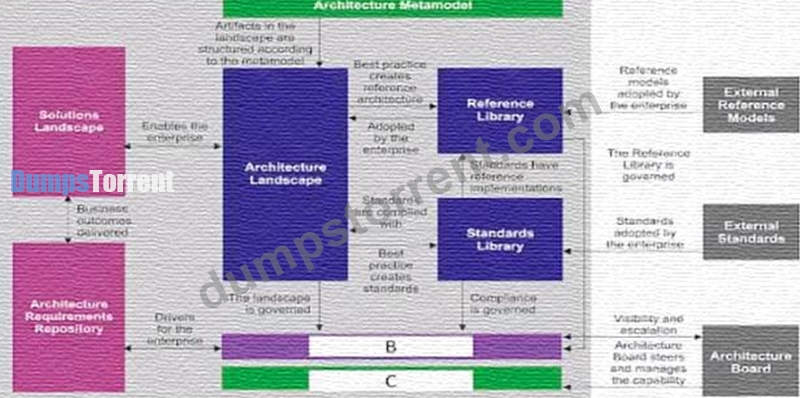
- A. A-Enterprise Repository, B-Governance Repository. C-Board Repository
- B. Enterprise Repository, B-Board repository, C-Enterprise Capability
- C. A-Architecture Repository, B-Governing Board, C-Enterprise Capability
- D. A-Architecture Repository, B-Governance Repository. C-Architecture Capability
Answer: C
Explanation:
In the provided diagram, item A refers to the Architecture Repository, which is a part of the TOGAF framework where all the architecture assets are stored. This includes the architectural models, patterns, architecture descriptions, and other artifacts relevant to the architecture. Item B is labeled as the Governing Board, which is likely referring to the Architecture Board or a similar governance structure responsible for oversight and decision-making regarding the enterprise architecture. Item C refers to Enterprise Capability, which encompasses the processes, tools, skills, and other capabilities that enable the architecture function within the enterprise.
NEW QUESTION # 56
......
Updated Test Engine to Practice OGBA-101 Dumps & Practice Exam: https://pass4sure.dumpstorrent.com/OGBA-101-exam-prep.html