

Get Nov-2024 updated Exam D-VPX-OE-A-24 Dumps with New Questions
100% Pass Guarantee for D-VPX-OE-A-24 Exam Dumps with Actual Exam Questions
NEW QUESTION # 26
In preparing a host to access its storage from VPLEX, what is considered a best practice when zoning?
- A. Ports on host HBA should be zoned to either an A director or a B director.
- B. Dual fabrics should be merged into a single fabric to ensure all zones are in a singlezoneset.
- C. Each host should have either one path to an A director or one path to a B director on each fabric, for a minimum of two logical paths.
- D. Each host should have at least one path to an A director and at least one path to a B director on each fabric, for a total of four logical paths.
Answer: D
Explanation:
When preparing a host to access its storage from VPLEX, the best practice for zoning is to ensure that each host has at least one path to an A director and at least one path to a B director on each fabric. This setup provides redundancy and ensures continuous availability of data even if one path or director fails.
* Redundant Paths: By having at least one path to an A director and one path to a B director, the host can maintain access to its storage even if one of the directors or paths becomes unavailable1.
* Fabric Configuration: The use of dual fabrics provides an additional layer of redundancy.Each fabric acts as an independent network, and having paths on both fabrics ensures that the host can still access storage if one fabric experiences issues1.
* Logical Paths: The total of four logical paths (two paths per fabric) allows for load balancing and failover capabilities.This configuration is crucial for environments that require high availability and resilience1.
* Zoning Best Practices: Proper zoning practices are essential for maintaining a secure and efficient storage network.The recommended zoning configuration helps to isolate traffic and prevent disruptions1.
* VPLEX Configuration: In a VPLEX environment, it is important to follow the recommended zoning practices to take full advantage of the system's capabilities for data mobility and continuous availability1.
By following this zoning best practice, administrators can ensure that the host has reliable and resilient access to its storage volumes through the VPLEX system.
NEW QUESTION # 27 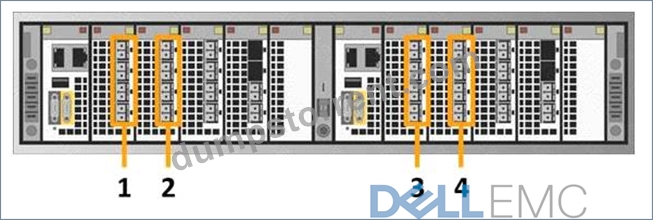
Which number in the exhibit highlights the Director-A back-end ports?
- A. 0
- B. 1
- C. 2
- D. 3
Answer: D
Explanation:
The image provided appears to be a diagram or photograph of the back panel of a Dell VPLEX system. The back panel is divided into two sections, each presumably representing a director module. Each section has a set of ports highlighted and labeled with numbers 1, 2, 3, and 4. According to the question provided, which asks to identify the Director-A back-end ports from the options given (OA 1, OB 2, OC 4, OD 3), the verified answer is number 3. This can be inferred because typically in such systems, 'A' might refer to the first director or left side when looking at the back panel.
NEW QUESTION # 28
What are characteristics of a storage view?
- A. An initiator can be in multiple storage views
VPLEX FE port can be in multiple storage views
Each initiator and FE port pair can only be in one storage view - B. An initiator can be in multiple storage views
VPLEX FE port can only be in one storage view
Each initiator and FE port pair can only be in one storage view - C. An initiator can only be in one storage view
VPLEX FE port can be in multiple storage views
Each initiator and FE port pair can be in different storage views - D. An initiator can only be in multiple storage view
VPLEX FE port can be in multiple storage views
Each initiator and FE port pair must be in different storage views
Answer: A
Explanation:
A storage view in Dell VPLEX is a logical construct that defines the visibility and access relationships between hosts (initiators), storage (virtual volumes), and VPLEX front-end (FE) ports. Here's a detailed explanation of the characteristics:
* Initiator Multiplicity:An initiator, which is typically a host's HBA (Host Bus Adapter) port, can indeed be part of multiple storage views. This allows a single host to access different sets of virtual volumes through different storage views.
* VPLEX FE Port Multiplicity:VPLEX FE ports can also be included in multiple storage views. This design provides flexibility in connecting multiple hosts to various virtual volumes through shared FE ports.
* Initiator and FE Port Pairing:While both initiators and FE ports can exist in multiple storage views, each unique initiator and FE port pair can only be part of one storage view. This rule ensures that the path from a host to a virtual volume through a specific FE port is uniquely defined, preventing any ambiguity in the data access path.
References:
* The Dell VPLEX documentation outlines the concept of storage views and their characteristics, emphasizing the importance of properly configuring storage views to ensure correct visibility and access control between hosts and storage resources1.
* Best practices guides and technical whitepapers provided by Dell further explain how to configure storage views in VPLEX, detailing the relationships between initiators, FE ports, and virtual volumes1.
By understanding these characteristics, a VPLEX storage administrator can effectively manage access to storage resources, ensuring that hosts have the necessary visibility to the virtual volumes they require for their operations.
NEW QUESTION # 29
Which command can be used to create a distributed virtual volume from specified storage volumes?
- A. storage-tool compose
- B. ds dd create
- C. virtual-volume create
- D. storage-volume compose
Answer: B
Explanation:
Questions no:Q34
Verified answer:D.ds dd create
Step by Step Comprehensive Detailed Explanation with References:
To create a distributed virtual volume from specified storage volumes in Dell VPLEX, the command used is ds dd create. This command stands for "distributed storage distributed device create" and is part of the VPLEX CLI (Command Line Interface) commands that manage distributed devices across clusters in a VPLEX Metro environment.
* Command Usage: The ds dd create command is used to create a distributed device, which is a virtual volume that spans across two VPLEX clusters, providing high availability and data mobility1.
* Distributed Virtual Volume: A distributed virtual volume in VPLEX is a volume that is accessible from both clusters in a VPLEX Metro configuration.It allows for simultaneous read and write operations from both locations1.
* Creating the Volume: The process involves specifying the storage volumes from each cluster that will be part of the distributed device.The command then creates a virtual volume that combines these storage volumes into a single distributed device1.
* High Availability: The resulting distributed virtual volume can be used in scenarios that require high availability, such as active-active data center configurations.It ensures that data is accessible even if one of the clusters becomes unavailable1.
* CLI Command Structure: The VPLEX CLI commands follow a structured format where the initial letters indicate the scope and type of operation.In this case, ds indicates distributed storage, and dd indicates a distributed device, which together specify the creation of a distributed virtual volume1.
By using the ds dd create command, administrators can effectively set up distributed virtual volumes in a VPLEX Metro environment, leveraging the system's capabilities for data availability and mobility.
NEW QUESTION # 30
Which type of statistics is used to track latencies, determine median, mode, percentiles, minimums, and maximums?
- A. Buckets
- B. Readings
- C. Counters
- D. Monitors
Answer: A
Explanation:
In the context of Dell VPLEX Operate, the type of statistics used to track latencies and determine statistical measures such as median, mode, percentiles, minimums, and maximums is referred to as "buckets." Buckets are a statistical method used to group data points into ranges or "buckets" to analyze the distribution and performance characteristics over time1.
* Buckets: Buckets are used in performance monitoring to categorize data points into defined ranges.This allows for a detailed analysis of how often data points fall within certain latency ranges, which is essential for understanding system performance1.
* Latency Tracking: By using buckets, VPLEX can track the latency of operations over time.This helps in identifying trends, such as increased latencies that may indicate potential performance issues1.
* Statistical Measures: Buckets enable the calculation of statistical measures like median, mode, percentiles, minimums, and maximums.These measures provide insights into the typical and extreme values of latencies experienced by the system1.
* Performance Analysis: The use of buckets is crucial for performance analysis, as it helps administrators understand the behavior of the system under different load conditions and during various operational scenarios1.
* Monitoring Tools: VPLEX provides monitoring tools that utilize buckets to present latency and other performance-related statistics in a way that is meaningful and actionable for system administrators1.
By leveraging buckets to track and analyze latencies and other performance metrics, VPLEX administrators can gain a comprehensive understanding of system behavior and make informed decisions to optimize performance and address any issues that arise.
NEW QUESTION # 31
A storage administrator has been tasked with encapsulating 100 LUNs across five Oracle servers from an existing array to a VPLEX Metro cluster. The administrator can obtain the same outage window for all five servers and wants to streamline as much of the encapsulation process as possible.
What can the administrator use to help achieve this task?
- A. Claim Storage Wizard
- B. SolVe Desktop utility
- C. storage-tool compose
- D. VIAS Provisioning Wizard
Answer: D
Explanation:
To streamline the encapsulation process of LUNs across multiple servers to a VPLEX Metro cluster, the storage administrator can use the VIAS (VPLEX Integrated Array Services) Provisioning Wizard. This tool simplifies the process by automating many of the steps involved in encapsulating LUNs.
Here's how the VIAS Provisioning Wizard can help:
* Preparation: The administrator can prepare many of the encapsulation tasks ahead of time, such as host zoning to VPLEX FE ports, host registration of initiators in VPLEX, and LUN masking/zoning to the VPLEX BE Ports1.
* Encapsulation Process: During the outage window, the administrator can use the VIAS Provisioning Wizard to encapsulate the LUNs under VPLEX control.Since the preparation steps like LUN masking and zoning to VPLEX BE have already been prepped, the cutover process becomes quicker1.
* Storage View Container Creation: The VIAS Provisioning Wizard allows for the creation of a Storage View container in VPLEX, where only the VPLEX FE ports are included initially1.
* EZ Provisioning Wizard: After claiming and encapsulating the LUNs, the administrator can create a
1:1 mapping of Storage volume to virtual volume with the EZ Provisioning Wizard, which is a quick process and helps preserve the data in its current state1.
* Finalizing the Cutover: The newly encapsulated 1:1 virtual volumes are added to the previously created Storage View container, and the previously registered host initiators are added to the Storage View as well1.
By using the VIAS Provisioning Wizard, the administrator can efficiently manage the encapsulation of a large number of LUNs, reducing the complexity and duration of the outage window required for such a task.
NEW QUESTION # 32
When is expanding a virtual volume using the Storage Volume expansion method a valid option?
- A. Virtual volume is a metadata volume
- B. Virtual volume is mapped 1:1 to the underlying storage volume
- C. Virtual volume previously expanded by adding extents or devices
- D. Virtual volume has minor problems, as reported by health-check
Answer: B
Explanation:
Expanding a virtual volume using the Storage Volume expansion method is a valid option when the virtual volume is mapped 1:1 to the underlying storage volume. This method is suitable when each virtual volume corresponds directly to a single storage volume on the backend array, and there is a need to expand the volume's capacity.
* 1:1 Mapping: A 1:1 mapping means that there is a direct relationship between a virtual volume in VPLEX and a single storage volume on the backend storage array.This allows for a straightforward expansion process as any increase in the size of the backend volume can be reflected in the virtual volume1.
* Storage Volume Expansion: The Storage Volume expansion method involves increasing the size of the backend storage volume first.This is typically done through the storage array's management interface1.
* VPLEX Recognition: Once the backend storage volume is expanded, VPLEX must recognize the new size.This may require rescanning the storage volumes within VPLEX to detect the changes1.
* Virtual Volume Expansion: After VPLEX recognizes the increased size of the storage volume, the corresponding virtual volume can be expanded to utilize the additional capacity.This is done within the VPLEX management interface1.
* Exclusion of Other Options: The other options listed, such as a virtual volume having minor problems, being a metadata volume, or previously expanded by adding extents or devices, are not typically associated with the Storage Volume expansion methD.These scenarios may require different approaches or may not be suitable for expansion using this method1.
By ensuring that the virtual volume is mapped 1:1 to the underlying storage volume, administrators can effectively utilize the Storage Volume expansion method to increase the capacity of virtual volumes in a VPLEX environment.
NEW QUESTION # 33
What can be used to monitor VPLEX performance parameters?
- A. VPLEX Cluster Witness
- B. EMC SolVe Desktop
- C. EMCREPORTS utility
- D. Unisphere Performance Monitor Dashboard
Answer: D
Explanation:
The Unisphere Performance Monitor Dashboard is used to monitor VPLEX performance parameters. This dashboard is part of the Unisphere for VPLEX management suite and provides a graphical interface for monitoring various performance metrics.
* Unisphere for VPLEX: Unisphere for VPLEX is the management interface for VPLEX systems.It provides administrators with tools to configure, manage, and monitor VPLEX environments1.
* Performance Monitoring: The Performance Monitor Dashboard within Unisphere allows administrators to view real-time and historical performance data.This includes metrics such as I/O rates, latency, and throughput1.
* Dashboard Features: The dashboard offers various features such as performance charts, threshold alerts, and detailed reports that help in identifying performance trends and potential issues1.
* Accessibility: The dashboard is accessible through the Unisphere web interface, making it convenient for administrators to monitor the VPLEX system from any location1.
* Usage: To use the Performance Monitor Dashboard, administrators log into Unisphere for VPLEX, navigate to the performance section, and can then view and analyze the performance data presented in the dashboard1.
By using the Unisphere Performance Monitor Dashboard, administrators can effectively monitor VPLEX performance parameters, ensuring the system operates efficiently and meets performance requirements.
NEW QUESTION # 34
What is a consideration when using VPLEX RecoverPoint enabled consistency groups?
- A. Production and local copy journals must be in different consistency groups.
- B. Local copy volumes and production volumes must reside in separate consistency groups.
- C. Local virtual volumes and distributed virtual volumes can be in the same consistency group.
- D. Repository volume and journal volumes must be in different consistency groups.
Answer: A
Explanation:
When using VPLEX with RecoverPoint enabled consistency groups, it's important to consider how journals are managed:
* Production Journals: These are used by the production volumes for logging write I/Os before they are replicated to the remote site or local copy.
* Local Copy Journals: These are used by the local copy volumes for the same purpose as production journals but are specific to the local copies.
* Separation of Journals: To ensure proper replication and recovery processes, production and local copy journals must be kept in separate consistency groups.This separation is crucial for maintaining the
* integrity of the replication and avoiding conflicts between production and local copy operations1.
* RecoverPoint Configuration: In a VPLEX environment, RecoverPoint provides continuous data protection and replication.It is configured to work with VPLEX consistency groups to ensure that all writes are captured and can be recovered in case of a failure1.
* Best Practices: Dell's best practices for VPLEX RecoverPoint configurations recommend this separation of journals to ensure that the system can handle failover scenarios correctly and that data is not lost or corrupted1.
By following this consideration, storage administrators can ensure that their VPLEX RecoverPoint environment is configured for optimal data protection and disaster recovery readiness.
NEW QUESTION # 35
How can a VPLEX storage administrator manage array-based attributes?
- A. Storage tiers
- B. Volume tiers
- C. Device tiers
- D. Extent tiers
Answer: A
Explanation:
A VPLEX storage administrator can manage array-based attributes throughstorage tiers. This is part of the VPLEX's ability to integrate with underlying storage arrays and leverage their native capabilities, such as tiering, to optimize performance and cost.
Here's a detailed explanation:
* Understanding Storage Tiers:Storage tiers are classifications of storage based on performance and cost. High-performance tiers use faster storage media like SSDs, while lower tiers might use traditional HDDs.
* VPLEX Integration:VPLEX integrates with underlying storage arrays to manage these tiers. By doing so, it can place data on the appropriate tier based on performance requirements and other policies.
* Managing Array-Based Attributes:Within the VPLEX, administrators can define policies that determine how data is placed across these tiers. This is done by managing array-based attributes that dictate tier placement.
* Provisioning and Migration:Administrators can provision new volumes or migrate existing ones between tiers as needed, ensuring that the most frequently accessed data is on the highest-performing tiers.
* Monitoring and Adjusting:VPLEX provides tools for monitoring performance and usage patterns, allowing administrators to adjust tiering policies and placements to optimize for current workloads.
* Documentation and Training:For those seeking to understand the full capabilities and management procedures, Dell provides training and documentation, such as the VPLEX Operate Achievement, which covers these topics in detail123.
By managing storage tiers, VPLEX administrators can ensure that the storage infrastructure is used efficiently, balancing cost and performance effectively.
NEW QUESTION # 36
LUNs are being provisioned from an ALUA-capable back-end array to VPLEX. What is the path requirement for each VPLEX director when connecting to this type of array?
- A. At least two paths to both the active and non-preferred array controllers
- B. At least two paths to the active array controller only
- C. At least two paths to every back-end array and storage volume
- D. At least two paths to both the active and passive array controllers
Answer: A
Explanation:
When provisioning LUNs from an ALUA-capable back-end array to VPLEX, it is required that each VPLEX director has at least two paths to both the active and non-preferred array controllers. This ensures redundancy and continuous availability of data even if one path or controller fails.
* ALUA-Capable Arrays: ALUA (Asymmetric Logical Unit Access) arrays present active and non-preferred (or passive) paths to the storage.The active paths are used for I/O under normal operations, while non-preferred paths are available for use if the active paths fail1.
* Path Requirements: For each VPLEX director, there should be at least two paths to the active controller and at least two paths to the non-preferred controller.This configuration provides redundancy and supports the ALUA functionality1.
* VPLEX Director Connectivity: VPLEX directors manage the paths to the storage arrays.Having multiple paths from each director ensures that VPLEX can continue to provide access to the LUNs even if there are issues with one of the paths or controllers1.
* Redundancy and Availability: The path requirement is crucial for maintaining high availability and redundancy, which are key benefits of using VPLEX in conjunction with ALUA-capable arrays1.
* Best Practices: Following this best practice for path connectivity aligns with VPLEX's goal of providing continuous data availability and seamless failover capabilities in the event of hardware failures or maintenance activities1.
By adhering to the path requirement of having at least two paths to both the active and non-preferred array controllers, VPLEX can leverage the ALUA functionality of the back-end array to ensure optimal performance and data availability.
NEW QUESTION # 37
Which data mobility operation removes the pointer to the source leg of a RAID-1 device?
- A. Commit
- B. Clean
- C. Remove
- D. Start
Answer: B
Explanation:
The data mobility operation that removes the pointer to the source leg of a RAID-1 device in Dell VPLEX is the "Clean" operation. This operation is part of the data mobility process in VPLEX, which involves migrating data from one storage volume to another.
* Data Mobility: Data mobility in VPLEX allows for the non-disruptive movement of data between storage volumes, which is often used for technology refreshes, load balancing, or other maintenance activities1.
* RAID-1 Device: A RAID-1 device in VPLEX is a virtual volume that provides data redundancy by mirroring data across two storage volumes, known as legs1.
* Clean Operation: The "Clean" operation is used after the data has been successfully migrated to the new storage volume (target leg).It removes the pointer from the old storage volume (source leg), effectively completing the migration process1.
* Pointer Removal: Removing the pointer to the source leg is an important step to ensure that the VPLEX system no longer references the old storage volume for read or write operations, and all I/O is
* directed to the new volume1.
* Finalization: Once the "Clean" operation is performed, the source leg can be safely decommissioned or repurposed, as it is no longer part of the RAID-1 device configuration1.
By using the "Clean" operation, administrators can ensure that the data mobility process is completed efficiently and that the VPLEX system maintains data integrity and continuity of service.
NEW QUESTION # 38
Which method of virtual volume expansion requires the volume to be expanded on the array first?
- A. Concatenation
- B. Extent expansion
- C. Storage volume
- D. RAID-C expansion
Answer: C
Explanation:
The method of virtual volume expansion that requires the volume to be expanded on the array first is the storage volume expansion methD.This method involves increasing the size of the physical storage volume on the array before expanding the virtual volume in VPLEX.
* Array Expansion: The first step is to expand the physical storage volume on the array.This is typically done through the array's management interface and involves adding more storage or extending the existing volume1.
* VPLEX Recognition: Once the storage volume is expanded on the array, VPLEX must recognize the new size of the volume.This may require a rescan or refresh within the VPLEX management interface1.
* Virtual Volume Expansion: After VPLEX recognizes the new size of the storage volume, the virtual volume can then be expanded to utilize the additional space.This is done within the VPLEX management interface, where the virtual volume is configured to include the additional capacity1.
* Storage Volume Method: The storage volume expansion method is distinct from other methods like concatenation, extent expansion, or RAID-C expansion, which involve different approaches to increasing virtual volume size within VPLEX itself1.
By expanding the storage volume on the array first, administrators can ensure that the additional capacity is available for use by VPLEX, allowing for the seamless expansion of virtual volumes to accommodate growing data needs.
NEW QUESTION # 39
A storage administrator has created a VPLEX distributed device. The administrator is performing application tests on the host utilizing the distributed virtual volumes. During testing, some of the write response times appear to be elongated.
What is a characteristic of distributed devices that explains this issue?
- A. Writes need to be written locally to multiple VPLEX Directors before sending a host acknowledgement.
- B. Writes need to be journaled in the VPLEX Witness logging volumes before sending a host acknowledgement.
- C. Writes need to be written to both clusters before sending a host acknowledgement.
- D. Writes need to be protected on the remote disk arrays only before sending a host acknowledgement.
Answer: C
Explanation:
When a VPLEX distributed device experiences elongated write response times, it is typically due to the characteristic of VPLEX that requires writes to be committed to backend storage on both clusters before an acknowledgement is sent to the host. This ensures data integrity and consistency across the distributed device but can lead to increased response times, especially if there is network congestion or latency issues between the clusters.
Here's a detailed explanation:
* Write I/O Commitment:For a VPLEX distributed device, any write I/O must be committed to backend (BE) storage on both the local and remote clusters1.
* Network Impact:If the inter-cluster communication network (FC/IP WAN) is experiencing congestion or high latency, it will increase the round-trip time of I/O packets, leading to performance issues and elongated write response times1.
* Performance Best Practices:VPLEX best practices suggest that the round-trip time (RTT) between clusters should not exceed 5 ms to maintain optimal performance, with an RTT of 1 ms recommended for campus-wide networks1.
* Troubleshooting Steps:To address such issues, administrators should check for network congestion indicators in the firmware logs and ensure that all WAN communication ports are operational and that SFPs have sufficient power1.
* Resolution:If the VPLEX is configured for FC metro and supported by Dell EMC, collecting switch logs and engaging Dell EMC support is advised.For IP metro configurations, validating the health of the IP network is crucial to identify the cause of congestion1.
By understanding this characteristic of VPLEX distributed devices, storage administrators can take appropriate measures to mitigate elongated write response times and maintain system performance.
NEW QUESTION # 40
Which mobility operation must be used to perform storage volume defragmentation?
- A. Extent mobility
- B. Data mobility
- C. Device mobility
- D. Virtual volume mobility
Answer: B
Explanation:
Data mobility in VPLEX is used for various operations, including storage volume defragmentation. Here's the explanation:
* Data Mobility: This operation is designed to move data within the VPLEX system, which can include moving data from fragmented storage volumes to contiguous storage, effectively defragmenting the storage1.
* Device Mobility: Device mobility is typically used for moving devices within the VPLEX cluster or across clusters but is not specifically for defragmentation purposes.
* Virtual Volume Mobility: While virtual volume mobility can move virtual volumes within the VPLEX environment, it does not directly address storage volume defragmentation.
* Extent Mobility: Extent mobility involves moving extents, which are segments of storage within a volume, but this is not the operation used specifically for defragmentation.
* Defragmentation Process: During defragmentation, data mobility would be used to relocate data from fragmented extents to a set of contiguous extents, thereby optimizing the layout of the data on the physical storage and improving performance1.
* VPLEX Administration Guides: For detailed procedures on how to perform data mobility operations, including defragmentation, administrators should refer to the VPLEX Administration Guides2.
By using data mobility operations, administrators can manage and optimize the storage within the VPLEX system, ensuring efficient use of resources and maintaining performance.
NEW QUESTION # 41
Which type of mobility is used to move data to a remote cluster in a VPLEX Metro?
- A. Extent
- B. MetroPoint
- C. Device
Virtual volume
Answer: C
Explanation:
In a VPLEX Metro environment, the type of mobility used to move data to a remote cluster is known as device mobility. This process involves the migration of virtual volumes that are backed by VPLEX devices across the two clusters that make up the VPLEX Metro.
Here's a detailed explanation:
* Device Mobility: Device mobility refers to the capability of VPLEX to move a device, which is a logical representation of storage, from one cluster to another within a VPLEX Metro configuration1.
* VPLEX Metro: VPLEX Metro is a configuration that allows for synchronous data replication and accessibility between two geographically separated clusters.It provides continuous availability and non-disruptive data mobility1.
* Migration Process: The migration of data in a VPLEX Metro involves several steps, starting with the creation of a mobility job, followed by the actual data movement, and finally, the cleanup and completion of the job1.
* CLI and GUI Tools: While earlier versions of VPLEX required the use of the Command Line Interface (CLI) for mobility in a Metro configuration, newer versions support this functionality through the Graphical User Interface (GUI) as well2.
* Use Cases: Device mobility is often used for load balancing, tech refreshes, or other scenarios where data needs to be moved between clusters without disrupting access to the data1.
By utilizing device mobility, VPLEX Metro allows for the seamless movement of data across clusters, ensuring high availability and flexibility in data management.
NEW QUESTION # 42
Which VPLEX model is recommended for VPLEX for All Flash (VAF)?
- A. VS1
- B. VS6 only
- C. VS2 and VS6
- D. VS2 only
Answer: C
NEW QUESTION # 43
How are physical ports numbered for each I/O module in VS6 VPLEX hardware?
- A. Director-A: 1 to 4 from the bottom
Director-B: 1 to 4 from the top - B. Director-A: 1 to 4 from the top
Director-B: 1 to 4 from the bottom - C. Director-A: 0 to 3 from the bottom
Director-B: 0 to 3 from the top - D. Director-A: 0 to 3 from the top
Director-B: 0 to 3 from the bottom
Answer: D
Explanation:
* Physical Port Numbering: Physical ports on I/O modules are numbered to provide a unique identifier for each port. This numbering is important for configuration, management, and troubleshooting purposes.
* Director Modules: In VPLEX hardware, director modules are key components that manage data flow and connectivity. Each director module contains I/O modules with multiple physical ports.
* Numbering Convention: The numbering convention for physical ports may start from either the top or the bottom of the I/O module, depending on the design specifications provided by the manufacturer1.
* VS6 VPLEX Hardware: For the VS6 VPLEX hardware, the specific numbering of physical ports for each I/O module would be detailed in the official Dell VPLEX documentation, which would provide diagrams and descriptions of the hardware components2.
* Configuration and Setup: Understanding the physical port numbering is crucial for the proper configuration and setup of the VPLEX system, as it affects zoning, mapping, and other storage network configurations3.
Since the exact numbering of physical ports for each I/O module in VS6 VPLEX hardware is not provided in the search results, it is recommended to consult the official Dell VPLEX documentation or contact Dell support for verified information.
-date and official guidance.
NEW QUESTION # 44
Which command collects the most recent performance statistics from all VPLEX directors?
- A. SNMPGETBULK
- B. SNMPGET
- C. monitor stat-list
- D. monitor collect
Answer: A
Explanation:
The command that collects the most recent performance statistics from all VPLEX directors is SNMPGETBULK. This command is part of the SNMP (Simple Network Management Protocol) suite, which is used for collecting information and managing network devices.
* SNMPGETBULK Command: The SNMPGETBULK command retrieves bulk data from SNMP-enabled devices.It is designed to efficiently collect multiple pieces of information in a single request, making it suitable for gathering performance statistics from multiple directors1.
* Usage in VPLEX: In the context of Dell VPLEX, the SNMPGETBULK command can be used to query the directors for their most recent performance data. This data can include metrics such as I/O rates, latency, cache usage, and other vital statistics.
* Performance Monitoring: Collecting performance statistics is crucial for monitoring the health and efficiency of the VPLEX system. It helps administrators identify potential issues and optimize the system's performance.
* SNMP Configuration: To use the SNMPGETBULK command, SNMP must be configured on the VPLEX system, and the appropriate community strings and access permissions must be set up.
* Other Commands: While the monitor stat-list command lists available statistics and the monitor collect command collects performance data for a specific monitor, the SNMPGETBULK command is specifically used for bulk data retrieval across all directors.
By utilizing the SNMPGETBULK command, administrators can effectively gather comprehensive performance data from all VPLEX directors, aiding in the management and optimization of the storage environment.
NEW QUESTION # 45
What condition would prevent volume expansion?
- A. Migration occurring on the volume
- B. Metadata volume being backed up
- C. Volume not belonging to a consistency group
- D. Logging volume in re-synchronization state
Answer: A
Explanation:
Volume expansion in Dell VPLEX is a process that allows for increasing the size of a virtual volume.
However, certain conditions can prevent this operation from taking place:
* Migration Occurring on the Volume: If there is an ongoing migration process involving the volume, it cannot be expanded until the migration is complete.This is because the volume's data layout is being altered during migration, and any attempt to change its size could lead to data corruption or other issues1.
* Consistency Group Membership: Whether or not a volume belongs to a consistency group does not directly prevent volume expansion. Consistency groups in VPLEX areused to ensure write-order fidelity across multiple volumes but do not restrict the expansion of individual volumes within the group.
* Metadata Volume Backup: Backing up a metadata volume is a separate operation that does not interfere with the ability to expand a storage volume. Metadata backups are typically performed to preserve the configuration and state information of the VPLEX system.
* Logging Volume Re-synchronization: While a logging volume in a re-synchronization state indicates that there is an ongoing process to align data across clusters or devices, it does not inherently prevent the expansion of a storage volume.
Therefore, the condition that would prevent volume expansion is when there is a migration occurring on the volume (OA).
NEW QUESTION # 46
What happens to global cache size if a director fails and is removed from the cluster?
- A. Suspends
- B. Increases
- C. Decreases
- D. Remains as-is
Answer: C
Explanation:
When a director fails and is removed from a VPLEX cluster, the global cache size decreases. This is because each director contributes to the total global cache available in the VPLEX cluster. Here's the explanation:
* Global Cache: The global cache in a VPLEX system is a shared resource that is used by all directors in the cluster to cache data for improved performance1.
* Director Contribution: Each director within the VPLEX cluster has its own local cache, which collectively forms the global cache.When a director is operational, its cache is part of the global cache pool1.
* Director Failure: If a director fails, its cache is no longer available to the cluster.As a result, the total size of the global cache is reduced by the amount that was contributed by the failed director1.
* Removal from Cluster: When the failed director is physically removed from the cluster, its cache is permanently removed from the global cache pool, resulting in a decrease in the total global cache size1.
* Impact on Performance: The reduction in global cache size may impact the performance of the VPLEX system, as there is less cache available for data storage and retrieval operations1.
* System Architecture: VPLEX architecture allows for multiple director failures without loss of access to data down to a single director, but the global cache size will decrease with each director failure1.
By understanding the role of each director's cache in contributing to the global cache, administrators can anticipate the effects of director failures on the overall performance of the VPLEX system.
NEW QUESTION # 47
A new VPLEX system has been installed that uses ESRS. The firewall administrator has opened ports 25,
9010, and 5901 between VPLEX and ESRS. A support ticket is
logged. While trying to troubleshoot, the technical support engineer cannot access the GUI of VPLEX.
Which port needs to be opened on the firewall?
- A. 0
- B. 1
- C. 2
- D. 3
Answer: A
Explanation:
When setting up a VPLEX system that uses ESRS (EMC Secure Remote Services), it is essential to ensure that the correct ports are open to allow for various types of communication, including access to the VPLEX GUI.
The port that needs to be opened on the firewall to allow access to the VPLEX GUI is port 443.
* Port 443: This port is commonly used for HTTPS traffic, which is the protocol used for secure web communications.The VPLEX GUI is accessed over a web browser using HTTPS, hence the need for port 443 to be open1.
* Firewall Configuration: The firewall administrator must configure the firewall to allow inbound and outbound traffic on port 443 to the VPLEX system's IP address.This ensures that the technical support engineer and other users can access the VPLEX GUI through a secure connection1.
* Troubleshooting Access Issues: If the technical support engineer cannot access the VPLEX GUI, one of the first steps in troubleshooting is to check the firewall settings to confirm that the necessary ports, including port 443, are open1.
* ESRS Communication: While ports 25, 9010, and 5901 are important for ESRS communication and other services, they do not facilitate access to the VPLEX GUI.Port 25 is typically used for SMTP email services, port 9010 may be used for internal services, and port 5901 could be used for VNC or other remote access protocols1.
* Secure Access: Opening port 443 not only allows access to the VPLEX GUI but also ensures that the communication is encrypted and secure, protecting sensitive data and system configurations1.
By opening port 443 on the firewall, the company ensures secure and reliable access to the VPLEX GUI for administration, monitoring, and troubleshooting purposes.
NEW QUESTION # 48
What steps are performed during extent and device migration?
- A. Start, commit, clean, and remove
- B. Create, clean, commit, and remove
- C. Start, commit, clean, and terminate
- D. Create, commit, clean, and terminate
Answer: D
Explanation:
The process of extent and device migration in a Dell VPLEX environment typically involves the following steps:
* Create: The initial step is to create a migration job for the extent or device. This involves specifying the source and target extents or devices and setting up the migration parameters.
* Commit: Once the migration job is created, the next step is to commit the jB.This action will start the migration process, where data begins to move from the source to the target.
* Clean: After the data has been successfully migrated, the system performs a cleanup operation to remove any temporary data structures or logs that were used during the migration process.
* Terminate: The final step is to terminate the migration jB.This step concludes the migration process and releases any resources that were allocated for the migration.
References:
* The Dell VPLEX documentation provides detailed procedures on how to perform data migration, including the steps involved in migrating extents and devices1.
* Best practices and technical guides from Dell also cover the topic of data migration, offering insights into the process and how to ensure a smooth migration experience1.
By following these steps, a storage administrator can successfully migrate extents and devices within the VPLEX environment, ensuring data availability and minimal disruption to services.
NEW QUESTION # 49
At which stage of configuring a virtual volume on VPLEX is the RAID level defined?
- A. Device
- B. Extent
- C. Storage volume
- D. Claimed volume
Answer: A
Explanation:
The RAID level for a virtual volume on VPLEX is defined at the device stage. Here's the explanation:
* Claimed Volume: This is the initial stage where a physical volume from a storage array is claimed by VPLEX. At this point, no RAID configuration is applied.
* Extent: After claiming the volume, VPLEX divides it into extents, which are logical subdivisions of the claimed volume. Extents still do not have RAID configurations.
* Device: This is the stage where RAID is applied. A VPLEX device is created from one or more extents, and it is at this point that the RAID level is defined.The device can be configured with various RAID levels, depending on the desired performance and redundancy requirements1.
* Storage Volume: The term 'storage volume' typically refers to the physical storage on the array before it is claimed by VPLEX. It does not have a RAID level associated with it until it is claimed and turned
* into a VPLEX device.
By defining the RAID level at the device stage, VPLEX allows for flexibility and resilience in how data is stored and protected across the storage infrastructure.
NEW QUESTION # 50
......
D-VPX-OE-A-24 exam dumps with real EMC questions and answers: https://pass4sure.dumpstorrent.com/D-VPX-OE-A-24-exam-prep.html