

FCSS_SASE_AD-25 Dumps with Free 365 Days Update Fast Exam Updates
Verified FCSS_SASE_AD-25 dumps Q&As - 2026 Latest FCSS_SASE_AD-25 Download
Fortinet FCSS_SASE_AD-25 Exam Syllabus Topics:
| Topic | Details |
|---|---|
| Topic 1 |
|
| Topic 2 |
|
| Topic 3 |
|
| Topic 4 |
|
NEW QUESTION # 11
Refer to the exhibit.
The daily report for application usage shows an unusually high number of unknown applications by category. What are two possible explanations for this? (Choose two.)
- A. Deep inspection is not being used to scan traffic.
- B. Zero trust network access (ZTNA) tags are not being used to tag the correct users.
- C. Certificate inspection is not being used to scan application traffic.
- D. The inline-CASB application control profile does not have application categories set to Monitor
Answer: A,D
NEW QUESTION # 12
A customer needs to implement device posture checks for their remote endpoints while accessing the protected server. They also want the TCP traffic between the remote endpoints and the protected servers to be processed by FortiGate.
In this scenario, which three setups will achieve the above requirements? (Choose three.)
- A. Configure private access policies on FortiSASE with ZTNA.
- B. Configure ZTNA tags on FortiGate.
- C. Sync ZTNA tags from FortiSASE to FortiGate.
- D. Configure ZTNA servers and ZTNA policies on FortiGate.
- E. Configure FortiGate as a zero trust network access (ZTNA) access proxy.
Answer: B,D,E
Explanation:
To meet the requirements of implementing device posture checks for remote endpoints and ensuring that TCP traffic between the endpoints and protected servers is processed by FortiGate, the following three setups are necessary:
Configure ZTNA tags on FortiGate (Option A):
ZTNA (Zero Trust Network Access) tags are used to define access control policies based on the security posture of devices. By configuring ZTNA tags on FortiGate, administrators can enforce granular access controls, ensuring that only compliant devices can access protected resources.
Configure FortiGate as a zero trust network access (ZTNA) access proxy (Option B):
FortiGate can act as a ZTNA access proxy, which allows it to mediate and secure connections between remote endpoints and protected servers. This setup ensures that all TCP traffic passes through FortiGate, enabling inspection and enforcement of security policies.
Configure ZTNA servers and ZTNA policies on FortiGate (Option C):
To enable ZTNA functionality, administrators must define ZTNA servers (the protected resources) and create ZTNA policies on FortiGate. These policies determine how traffic is routed, inspected, and controlled based on device posture and user identity.
Here's why the other options are incorrect:
D . Configure private access policies on FortiSASE with ZTNA: While FortiSASE supports ZTNA, the requirement specifies that TCP traffic must be processed by FortiGate. Configuring private access policies on FortiSASE would route traffic through FortiSASE instead of FortiGate, which does not meet the stated requirements.
E . Sync ZTNA tags from FortiSASE to FortiGate: Synchronizing ZTNA tags is unnecessary in this scenario because the focus is on FortiGate processing the traffic. The tags can be directly configured on FortiGate without involving FortiSASE.
Fortinet FCSS FortiSASE Documentation - Zero Trust Network Access (ZTNA) Deployment FortiGate Administration Guide - ZTNA Configuration
NEW QUESTION # 13
Which service is included in a secure access service edge (SASE) solution, but not in a security service edge (SSE) solution?
- A. SD-WAN
- B. CASB
- C. SWG
- D. ZTNA
Answer: A
Explanation:
SD-WAN is a networking component included in a SASE solution but not in an SSE solution. SSE focuses solely on security services (like ZTNA, SWG, and CASB), while SASE combines both networking (e.g., SD- WAN) and security into a unified cloud-delivered service.
NEW QUESTION # 14
Refer to the exhibits.

When remote users connected to FortiSASE require access to internal resources on Branch-2. how will traffic be routed?
- A. FortiSASE will use the SD-WAN capability and determine that traffic will be directed to HUB-1, which will then route traffic to Branch-2.
- B. FortiSASE will use the SD-WAN capability and determine that traffic will be directed to HUB-2. which will then route traffic to Branch-2.
- C. FortiSASE will use the AD VPN protocol and determine that traffic will be directed to Branch-2 directly, using a static route
- D. FortiSASE will use the AD VPN protocol and determine that traffic will be directed to Branch-2 directly, using a dynamic route
Answer: D
NEW QUESTION # 15
What are two benefits of deploying FortiSASE with FortiGate ZTNA access proxy? (Choose two.)
- A. It is ideal for latency-sensitive applications.
- B. The on-premises FortiGate performs a device posture check.
- C. It supports both agentless ZTNA and agent-based ZTNA.
- D. It offers data center redundancy.
Answer: A,C
Explanation:
Deploying FortiSASE with FortiGate ZTNA access proxy enables efficient access to private applications with reduced latency and supports both agentless and agent-based ZTNA methods for flexible access control.
NEW QUESTION # 16
Refer to the exhibits.

A FortiSASE administrator has configured an antivirus profile in the security profile group and applied it to the internet access policy. Remote users are still able to download the eicar.com-zip file from https://eicar.org.
Which configuration on FortiSASE is allowing users to perform the download?
- A. Application control is exempting all the browser traffic.
- B. Deep inspection is not enabled.
- C. Intrusion prevention is disabled.
- D. Web filter is allowing the URL.
Answer: B
Explanation:
The SSL inspection mode is set to certificate inspection, which only inspects SSL/TLS headers and does not allow full scanning of encrypted content. Without full (deep) inspection, the antivirus profile cannot scan or block malicious files (like eicar.com-zip) delivered over HTTPS, allowing the download to proceed.
NEW QUESTION # 17
Refer to the exhibits.


A FortiSASE administrator has configured FortiSASE as a spoke to a FortiGate hub. The tunnel is up to the FortiGate hub. However, the remote FortiClient is not able to access the web server hosted behind the FortiGate hub.
Based on the exhibits, what is the reason for the access failure?
- A. The server subnet BGP route was not received on FortiSASE.
- B. A private access policy has denied the traffic because of failed compliance
- C. The hub is not advertising the required routes.
- D. The hub firewall policy does not include the FortiClient address range.
Answer: A
Explanation:
The FortiSASE BGP learned routes do not include the 10.160.160.0/24 subnet (server network). Although the FortiGate hub is advertising this route (10.160.160.0/24) to FortiSASE, it is not visible in the FortiSASE BGP route table - indicating a routing issue. Without this route, FortiSASE cannot forward traffic from FortiClient to the server.
NEW QUESTION # 18
Which two advantages does FortiSASE bring to businesses with multiple branch offices? (Choose two.)
- A. It eliminates the need to have an on-premises firewall for each branch.
- B. It enables seamless integration with third-party firewalls.
- C. it offers customizable dashboard views for each branch location
- D. It offers centralized management for simplified administration.
Answer: A,D
Explanation:
FortiSASE brings the following advantages to businesses with multiple branch offices:
Centralized Management for Simplified Administration:
FortiSASE provides a centralized management platform that allows administrators to manage security policies, configurations, and monitoring from a single interface.
This simplifies the administration and reduces the complexity of managing multiple branch offices.
Eliminates the Need for On-Premises Firewalls:
FortiSASE enables secure access to the internet and cloud applications without requiring dedicated on-premises firewalls at each branch office.
This reduces hardware costs and simplifies network architecture, as security functions are handled by the cloud-based FortiSASE solution.
FortiOS 7.2 Administration Guide: Provides information on the benefits of centralized management and cloud-based security solutions.
FortiSASE 23.2 Documentation: Explains the advantages of using FortiSASE for businesses with multiple branch offices, including reduced need for on-premises firewalls.
NEW QUESTION # 19
Refer to the exhibit.
A company has a requirement to inspect all the endpoint internet traffic on FortiSASE, and exclude Google Maps traffic from the FortiSASE VPN tunnel and redirect it to the endpoint physical Interface. Which configuration must you apply to achieve this requirement?
- A. Change the default DNS server configuration on FortiSASE to use the endpoint system DNS.
- B. Exempt the Google Maps FQDN from the endpoint system proxy settings.
- C. Configure a static route with the Google Maps FQDN on the endpoint to redirect traffic
- D. Configure the Google Maps FQDN as a split tunneling destination on the FortiSASE endpoint profile.
Answer: D
Explanation:
To meet the requirement of inspecting all endpoint internet traffic on FortiSASE while excluding Google Maps traffic from the FortiSASE VPN tunnel and redirecting it to the endpoint's physical interface, you should configure split tunneling. Split tunneling allows specific traffic to bypass the VPN tunnel and be routed directly through the endpoint's local interface.
Split Tunneling Configuration:
Split tunneling enables selective traffic to be routed outside the VPN tunnel.
By configuring the Google Maps Fully Qualified Domain Name (FQDN) as a split tunneling destination, you ensure that traffic to Google Maps bypasses the VPN tunnel and uses the endpoint's local interface instead.
Implementation Steps:
Access the FortiSASE endpoint profile configuration.
Add the Google Maps FQDN to the split tunneling destinations list.
This configuration directs traffic intended for Google Maps to bypass the VPN tunnel and be routed directly through the endpoint's physical network interface.
FortiOS 7.2 Administration Guide: Provides details on split tunneling configuration.
FortiSASE 23.2 Documentation: Explains how to set up and manage split tunneling for specific destinations.
NEW QUESTION # 20
Refer to the exhibit.
While reviewing the traffic logs, the FortiSASE administrator notices that the usernames are showing random characters.
Why are the usernames showing random characters?
- A. Special characters are used in usernames.
- B. FortiSASE uses FortiClient unique identifiers for usernames.
- C. Log anonymization is turned on to hash usernames.
- D. Users are using a shared single sign-on SSO username.
Answer: C
Explanation:
The usernames appear as random character strings because log anonymization is enabled in FortiSASE, which hashes sensitive user information such as usernames to protect privacy while still allowing log analysis.
NEW QUESTION # 21
Refer to the exhibits.
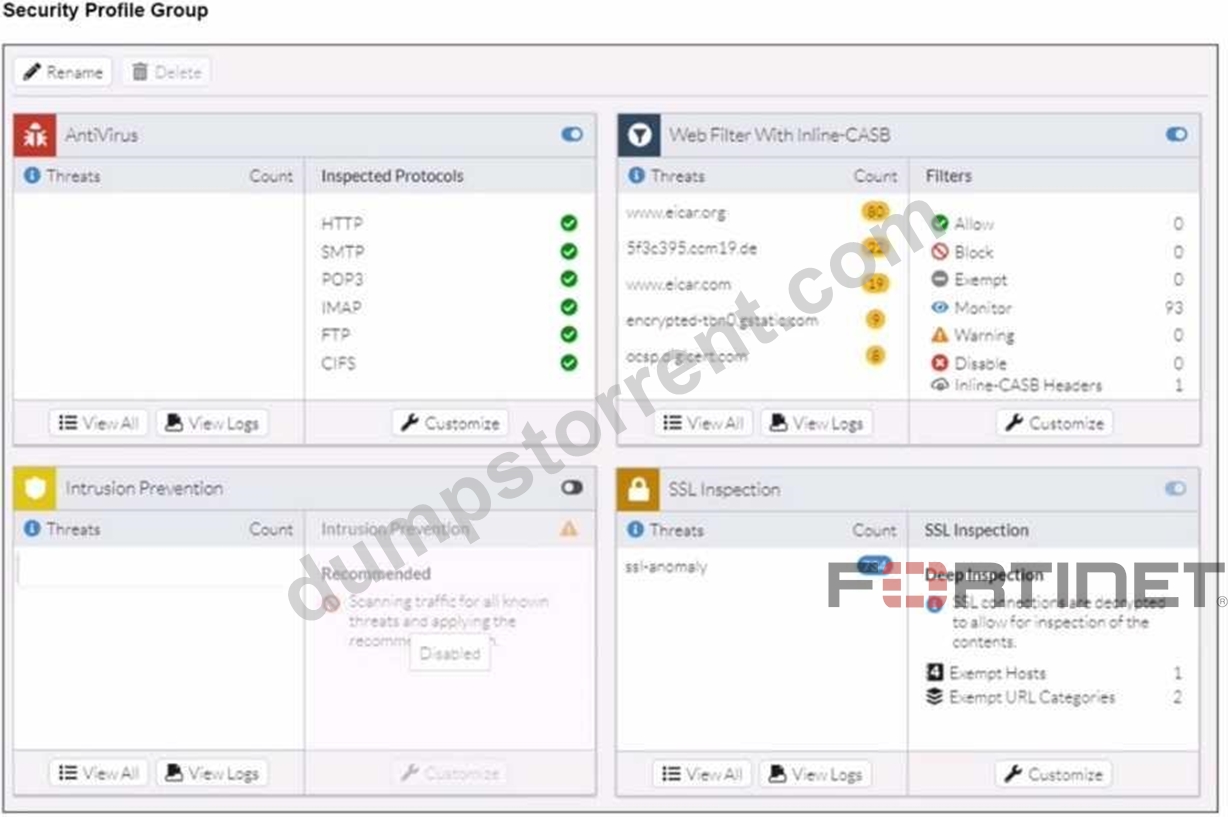

A FortiSASE administrator has configured an antivirus profile in the security profile group and applied it to the internet access policy. Remote users are still able to download the eicar.com-zip file from https://eicar.org. Traffic logs show traffic is allowed by the policy. Which configuration on FortiSASE is allowing users to perform the download?
- A. The HTTPS protocol is not enabled in the antivirus profile.
- B. Force certificate inspection is enabled in the policy.
- C. Web filter is allowing the traffic.
- D. IPS is disabled in the security profile group.
Answer: B
Explanation:
https://community.fortinet.com/t5/FortiSASE/Technical-Tip-Force-Certificate-Inspection-option-in-FortiSASE/ta-p/302617
NEW QUESTION # 22
Refer to the exhibit.
A company has a requirement to inspect all the endpoint internet traffic on FortiSASE, and exclude Google Maps traffic from the FortiSASE VPN tunnel and redirect it to the endpoint physical Interface. Which configuration must you apply to achieve this requirement?
- A. Change the default DNS server configuration on FortiSASE to use the endpoint system DNS.
- B. Exempt the Google Maps FQDN from the endpoint system proxy settings.
- C. Configure a static route with the Google Maps FQDN on the endpoint to redirect traffic
- D. Configure the Google Maps FQDN as a split tunneling destination on the FortiSASE endpoint profile.
Answer: D
Explanation:
To meet the requirement of inspecting all endpoint internet traffic on FortiSASE while excluding Google Maps traffic from the FortiSASE VPN tunnel and redirecting it to the endpoint's physical interface, you should configure split tunneling. Split tunneling allows specific traffic to bypass the VPN tunnel and be routed directly through the endpoint's local interface.
Split Tunneling Configuration:
Split tunneling enables selective traffic to be routed outside the VPN tunnel.
By configuring the Google Maps Fully Qualified Domain Name (FQDN) as a split tunneling destination, you ensure that traffic to Google Maps bypasses the VPN tunnel and uses the endpoint's local interface instead.
Implementation Steps:
Access the FortiSASE endpoint profile configuration.
Add the Google Maps FQDN to the split tunneling destinations list.
This configuration directs traffic intended for Google Maps to bypass the VPN tunnel and be routed directly through the endpoint's physical network interface.
FortiOS 7.2 Administration Guide: Provides details on split tunneling configuration.
FortiSASE 23.2 Documentation: Explains how to set up and manage split tunneling for specific destinations.
NEW QUESTION # 23
For a SASE deployment, what is a crucial step when configuring security checks for regulatory compliance?
- A. Annual reviews of compliance status
- B. Continuous monitoring and automatic updates of compliance rules
- C. Manual verification by external auditors
- D. Periodic rollback of security updates
Answer: B
NEW QUESTION # 24
Refer to the exhibit.
The daily report for application usage for internet traffic shows an unusually high number of unknown applications by category.
What are two possible explanations for this? (Choose two.)
- A. Deep inspection is not being used to scan traffic.
- B. The private access policy must be to set to log Security Events.
- C. Certificate inspection is not being used to scan application traffic.
- D. The inline-CASB application control profile does not have application categories set to Monitor.
Answer: A,C
NEW QUESTION # 25
An organization must block user attempts to log in to non-company resources while using Microsoft Office
365 to prevent users from accessing unapproved cloud resources.
Which FortiSASE feature can you implement to meet this requirement?
- A. application control with inline-CASB
- B. web filter with inline-CASB
- C. data loss prevention (DLP) with Microsoft Purview Information Protection (MPIP)
- D. DNS filter with domain filter
Answer: A
Explanation:
Application control with inline-CASB allows FortiSASE to inspect and control application behavior at a granular level. This enables the organization to block login attempts to personal or non-corporate Microsoft Office 365 accounts, ensuring that only approved cloud resources are accessed.
NEW QUESTION # 26
What can be configured on FortiSASE as an additional layer of security for FortiClient registration?
- A. device identification
- B. security posture tags
- C. user verification
- D. application inventory
Answer: C
NEW QUESTION # 27
Refer to the exhibit.
The daily report for application usage shows an unusually high number of unknown applications by category. What are two possible explanations for this? (Choose two.)
- A. Deep inspection is not being used to scan traffic.
- B. Zero trust network access (ZTNA) tags are not being used to tag the correct users.
- C. Certificate inspection is not being used to scan application traffic.
- D. The inline-CASB application control profile does not have application categories set to Monitor
Answer: A,D
NEW QUESTION # 28
Which two components are part of onboarding a secure web gateway (SWG) endpoint? (Choose two)
- A. FortiSASE CA certificate
- B. proxy auto-configuration (PAC) file
- C. FortiClient installer
- D. FortiSASE invitation code
Answer: A,B
Explanation:
Onboarding a Secure Web Gateway (SWG) endpoint involves several components to ensure secure and effective integration with FortiSASE. Two key components are the FortiSASE CA certificate and the proxy auto-configuration (PAC) file.
FortiSASE CA Certificate:
The FortiSASE CA certificate is essential for establishing trust between the endpoint and the FortiSASE infrastructure.
It ensures that the endpoint can securely communicate with FortiSASE services and inspect SSL/TLS traffic.
Proxy Auto-Configuration (PAC) File:
The PAC file is used to configure the endpoint to direct web traffic through the FortiSASE proxy.
It provides instructions on how to route traffic, ensuring that all web requests are properly inspected and filtered by FortiSASE.
FortiOS 7.2 Administration Guide: Details on onboarding endpoints and configuring SWG.
FortiSASE 23.2 Documentation: Explains the components required for integrating endpoints with FortiSASE and the process for deploying the CA certificate and PAC file.
NEW QUESTION # 29
Which event log subtype captures FortiSASE SSL VPN user creation?
- A. User Events
- B. Endpoint Events
- C. VPN Events
- D. Administrator Events
Answer: A
Explanation:
The event log subtype that captures FortiSASE SSL VPN user creation is User Events . This subtype is specifically designed to log activities related to user management, such as creating, modifying, or deleting user accounts. When an SSL VPN user is created, it falls under this category because it involves adding a new user to the system.
Here's why the other options are incorrect:
A . Endpoint Events: These logs pertain to activities related to endpoint devices, such as device registration, compliance checks, or security posture assessments. SSL VPN user creation is unrelated to endpoint events.
B . VPN Events: These logs capture activities related to VPN connections, such as session establishment, termination, or errors. While SSL VPN usage generates VPN events, the creation of a user account itself is not logged under this subtype.
D . Administrator Events: These logs track actions performed by administrators, such as configuration changes or policy updates. While an administrator might create the SSL VPN user, the specific event of user creation is categorized under User Events, not Administrator Events.
Fortinet FCSS FortiSASE Documentation - Event Logging and Subtypes
FortiSASE Administration Guide - Monitoring and Logging
NEW QUESTION # 30
How does FortiSASE hide user information when viewing and analyzing logs?
- A. By masking log data
- B. By tokenization in log data
- C. By compressing log data
- D. By hashing log data
Answer: D
Explanation:
FortiSASE hides user information in logs by using hashing, which anonymizes sensitive data such as usernames or IP addresses while still allowing for consistent tracking and analysis.
NEW QUESTION # 31
Which feature should be prioritized when configuring dashboards in FortiSASE for monitoring network traffic?
- A. Real-time traffic flow
- B. Historical bandwidth usage
- C. User access logs
- D. Comparative analysis of past and present data
Answer: A
NEW QUESTION # 32
Which secure internet access (SIA) use case minimizes individual workstation or device setup, because you do not need to install FortiClient on endpoints or configure explicit web proxy settings on web browser-based end points?
- A. SIA for agentless remote users
- B. SIA for inline-CASB users
- C. SIA for SSLVPN remote users
- D. SIA for site-based remote users
Answer: A
Explanation:
The Secure Internet Access (SIA) use case that minimizes individual workstation or device setup is SIA for agentless remote users. This use case does not require installing FortiClient on endpoints or configuring explicit web proxy settings on web browser-based endpoints, making it the simplest and most efficient deployment.
SIA for Agentless Remote Users:
Agentless deployment allows remote users to connect to the SIA service without needing to install any client software or configure browser settings.
This approach reduces the setup and maintenance overhead for both users and administrators.
Minimized Setup:
Without the need for FortiClient installation or explicit proxy configuration, the deployment is straightforward and quick.
Users can securely access the internet with minimal disruption and administrative effort.
FortiOS 7.2 Administration Guide: Details on different SIA deployment use cases and configurations.
FortiSASE 23.2 Documentation: Explains how SIA for agentless remote users is implemented and the benefits it provides.
NEW QUESTION # 33
......
Updated Fortinet Study Guide FCSS_SASE_AD-25 Dumps Questions: https://pass4sure.dumpstorrent.com/FCSS_SASE_AD-25-exam-prep.html