

Updated FCP_FSM_AN-7.2 Dumps PDF - FCP_FSM_AN-7.2 Real Valid Brain Dumps With 63 Questions!
100% Free FCP_FSM_AN-7.2 Exam Dumps Use Real Fortinet Certified Professional Security Operations Dumps
Fortinet FCP_FSM_AN-7.2 Exam Syllabus Topics:
| Topic | Details |
|---|---|
| Topic 1 |
|
| Topic 2 |
|
| Topic 3 |
|
| Topic 4 |
|
NEW QUESTION # 20
Refer to the exhibit.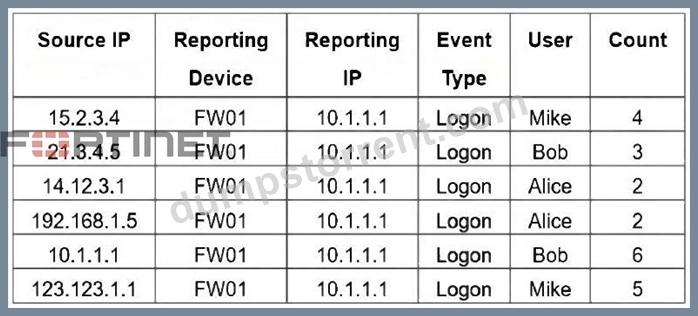
If you group the events by User, Source IP, and Count attributes, how many results will FortiSIEM display?
- A. Six
- B. Four
- C. Two
- D. Three
- E. Five
Answer: A
Explanation:
Grouping by User, Source IP, and Count means that each unique combination of those three attributes will be treated as a separate result. In the table, all six rows have distinct combinations of User, Source IP, and Count - so FortiSIEM will display 6 results.
NEW QUESTION # 21
Which analytics search can be used to apply a user and entity behavior analytics (UEBA) tag to an event for a failed login by the user JSmith?
- A. Username CONTAIN smit
- B. Username NOT END WITH jsmith
- C. User = smith
- D. User IS jsmith
Answer: D
Explanation:
The correct syntax to match an exact username in FortiSIEM analytics search is User IS jsmith.
This ensures that the UEBA tag is applied only when the event is specifically tied to the user
"jsmith", which is required for accurate behavioral analytics.
NEW QUESTION # 22
From which two sources can you import data to train FortiSIEM machine learning? (Choose two.)
- A. Syslog archives
- B. FortiSIEM reports
- C. CSV files
- D. SQL database
Answer: B,C
NEW QUESTION # 23
When configuring anomaly detection machine learning, in which step must you select the fields to analyze?
- A. Train
- B. Design
- C. Prepare Data
- D. Schedule
Answer: C
Explanation:
In the Prepare Data step of configuring anomaly detection in FortiSIEM, you must select the fields to analyze. This step defines the input features that the machine learning model will evaluate during training and detection.
NEW QUESTION # 24
Refer to the exhibit.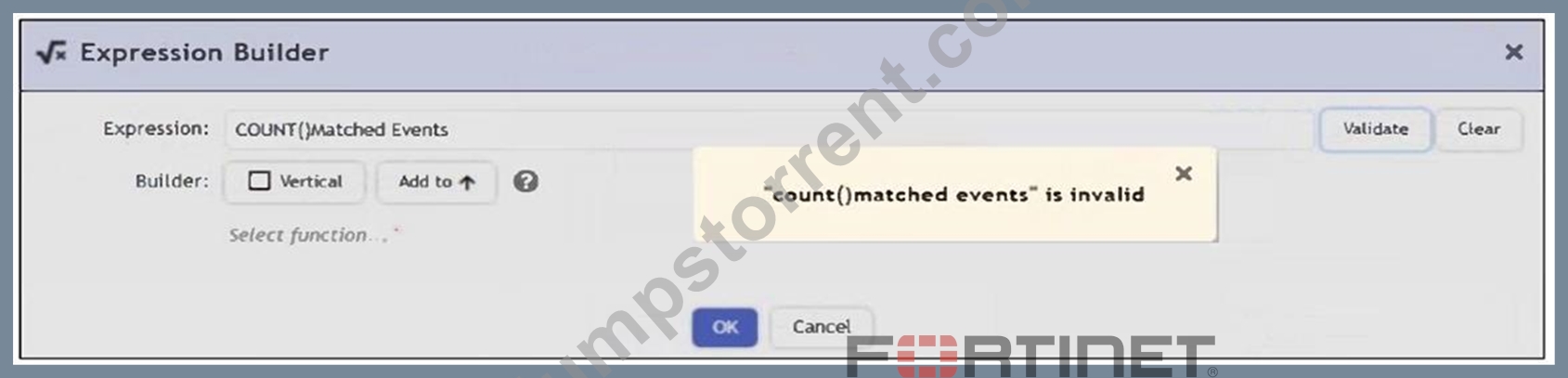
An analyst is trying to identify an issue using an expression based on the Expression Builder settings shown in the exhibit; however, the error message shown in the exhibit indicates that the expression is invalid.
What is the correct syntax to create an expression that generates a total count of matched events?
- A. Matched Events (COUNT)
- B. (COUNT) Matched Events
- C. COUNT(Matched Events)
- D. Matched Events COUNT()
Answer: C
Explanation:
The correct syntax is COUNT(Matched Events) - with proper capitalization and spacing - to generate a total count of matched events. The error in the exhibit likely stems from a formatting issue (e.g., lowercase count() or incorrect spacing), not the logical structure of the expression.
NEW QUESTION # 25
Refer to the exhibit. The analyst is troubleshooting the analytics query shown in the exhibit.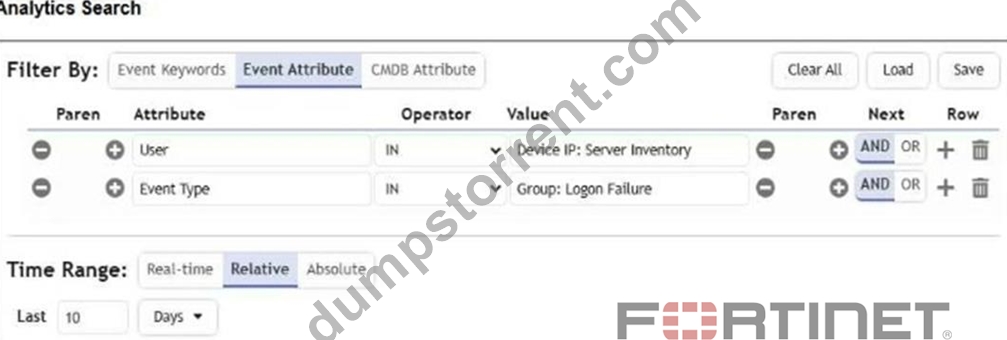
Why is this search not producing any results?
- A. You cannot reference User and Event Type attributes in the same search.
- B. The inner and outer nested query attribute types do not match.
- C. The Time Range is set incorrectly.
- D. The Boolean operator is wrong between the attributes.
Answer: B
Explanation:
The issue is that the "User" attribute is incorrectly assigned a Device IP group value, which is a mismatch of attribute types. "User" expects a user name or identity, not a device IP group. This mismatch between the attribute type and the provided value causes the search to return no results.
NEW QUESTION # 26
Which two settings must you configure to allow FortiSIEM to apply tags to devices in FortiClient EMS? (Choose two.)
- A. FortiSIEM API credentials defined on FortiEMS\
- B. FortiEMS API credentials defined on FortiSIEM
- C. Remediation script configured
- D. ZTNA tags defined on FortiSIEM
Answer: A,B
Explanation:
To allow FortiSIEM to apply tags to devices in FortiClient EMS, FortiEMS API credentials must be defined on FortiSIEM to enable communication with EMS, and FortiSIEM API credentials must be defined on FortiEMS to allow EMS to accept tagging instructions from FortiSIEM. This bidirectional API trust is essential for tag application.
NEW QUESTION # 27
Refer to the exhibit.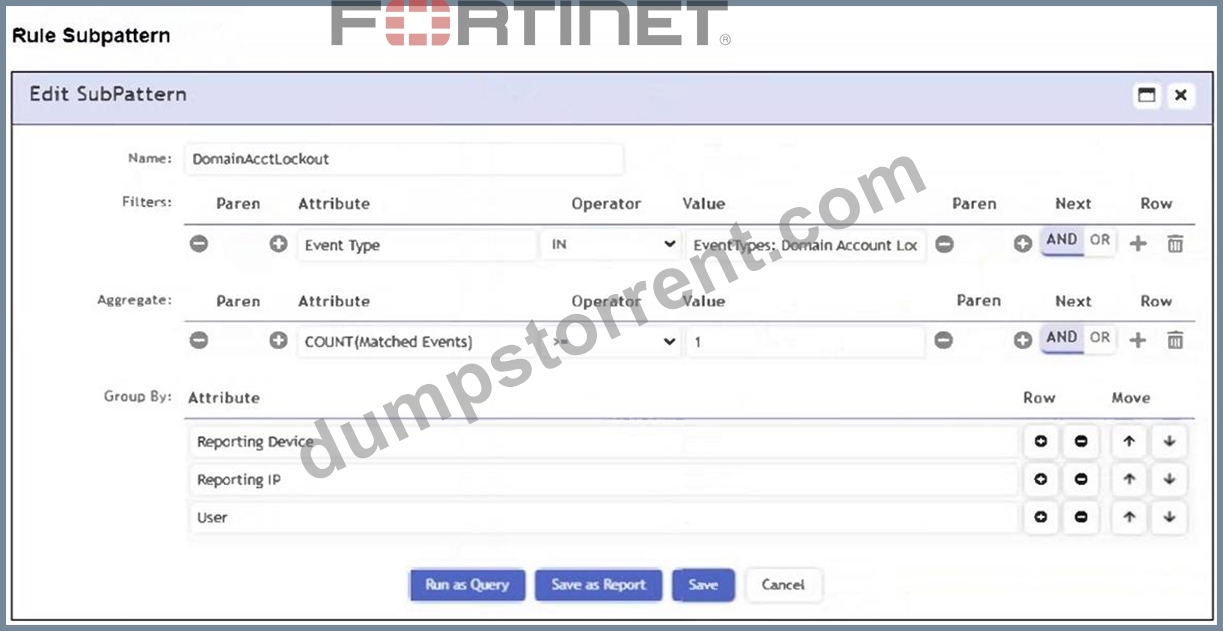
Which section contains the subpattern configuration that determines how many matching events are needed to trigger the rule?
- A. Aggregate
- B. Actions
- C. Group By
- D. Filters
Answer: A
Explanation:
The Aggregate section contains the condition COUNT(Matched Events) >= 1, which defines how many events must match the filter criteria for the rule to trigger. This is the subpattern configuration that determines the event threshold.
NEW QUESTION # 28
Refer to the exhibit.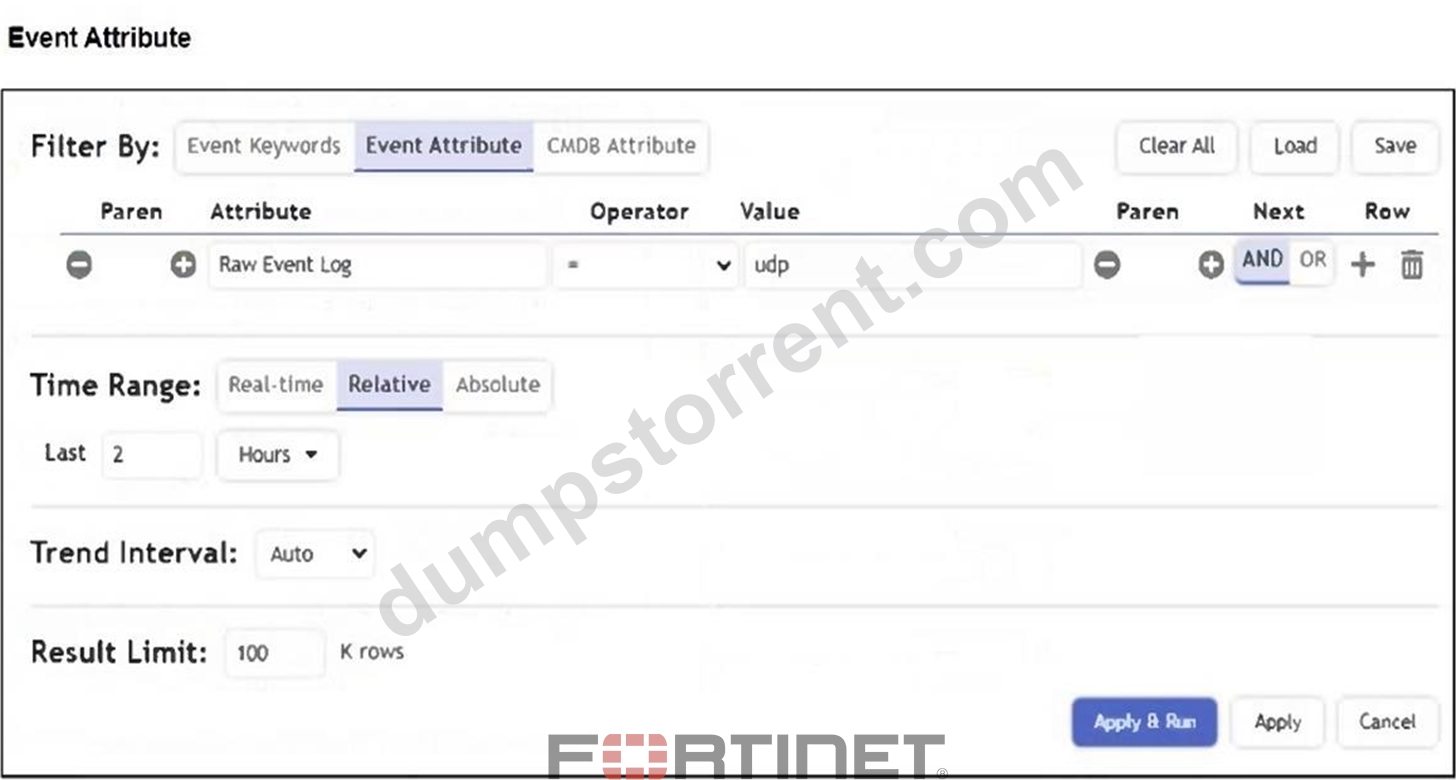
A FortiSIEM device is receiving syslog events from a FortiGate firewall. The FortiSIEM analyst is trying to search the raw event logs for the last two hours that contain the keyword "udp".
However, they are getting no results from the search, which they know should be available.
Based on the filter shown in the exhibit, why are there no search results?
- A. The Time Range value should be set to Real-Time.
- B. The analyst selected = in the Operator column. That is the wrong operator.
- C. The keyword is case sensitive. Instead of typing udp in the Value field, the analyst should type UDP.
- D. The analyst selected AND in the Next column. This is the wrong Boolean operator.
Answer: B
Explanation:
The operator is set to "=", which performs an exact match on the entire raw event log, not a substring search. To find logs that contain the keyword "udp", the analyst should use the CONTAIN operator instead. This will return all logs where "udp" appears anywhere in the raw log message.
NEW QUESTION # 29
Refer to the exhibit.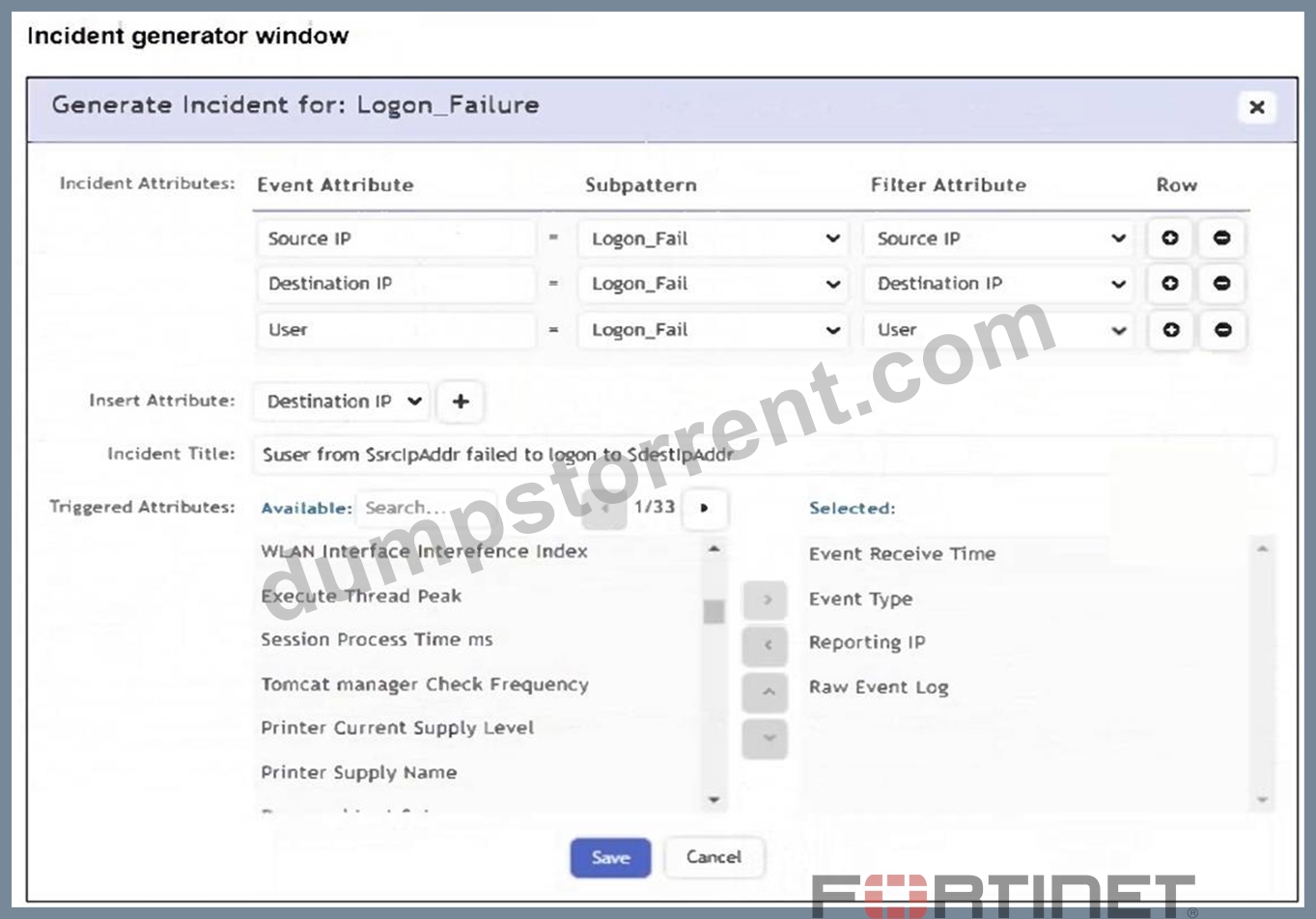
An analyst is trying to generate an incident with a title that includes the Source IP, Destination IP, User, and Destination Host Name. They are unable to add a Destination Host Name as an incident attribute.
What must be changed to allow the analyst to select Destination Host Name as an attribute?
- A. The Destination Host Name must be added as an Event type in the FortiSIEM.
- B. The Destination Host Name must be selected as a Triggered Attribute.
- C. The Destination Host Name must be set as an aggregate item in a subpattern.
- D. The Destination IP Event Attribute must be removed.
Answer: B
Explanation:
For an attribute like Destination Host Name to be used in the incident title, it must first be included in the Triggered Attributes list. Only attributes listed there are available for substitution in the title template (e.g., $destIpAddr, $srcIpAddr).
NEW QUESTION # 30
Refer to the exhibit. Which value would be saved as the Event Type attribute by the default FortiSIEM parser?
- A. PH_DEV_MON_SYS_UPTIME
- B. diskUtil
- C. sysUpTime
- D. PHL_INFO
Answer: A
Explanation:
In FortiSIEM, the Event Type attribute is derived from the value preceding the colon in the raw message header. In this case, the raw message begins with [PH_DEV_MON_SYS_UPTIME], so the parser assigns PH_DEV_MON_SYS_UPTIME as the Event Type. This identifies the event as a system uptime monitoring message.
NEW QUESTION # 31
Refer to the exhibit.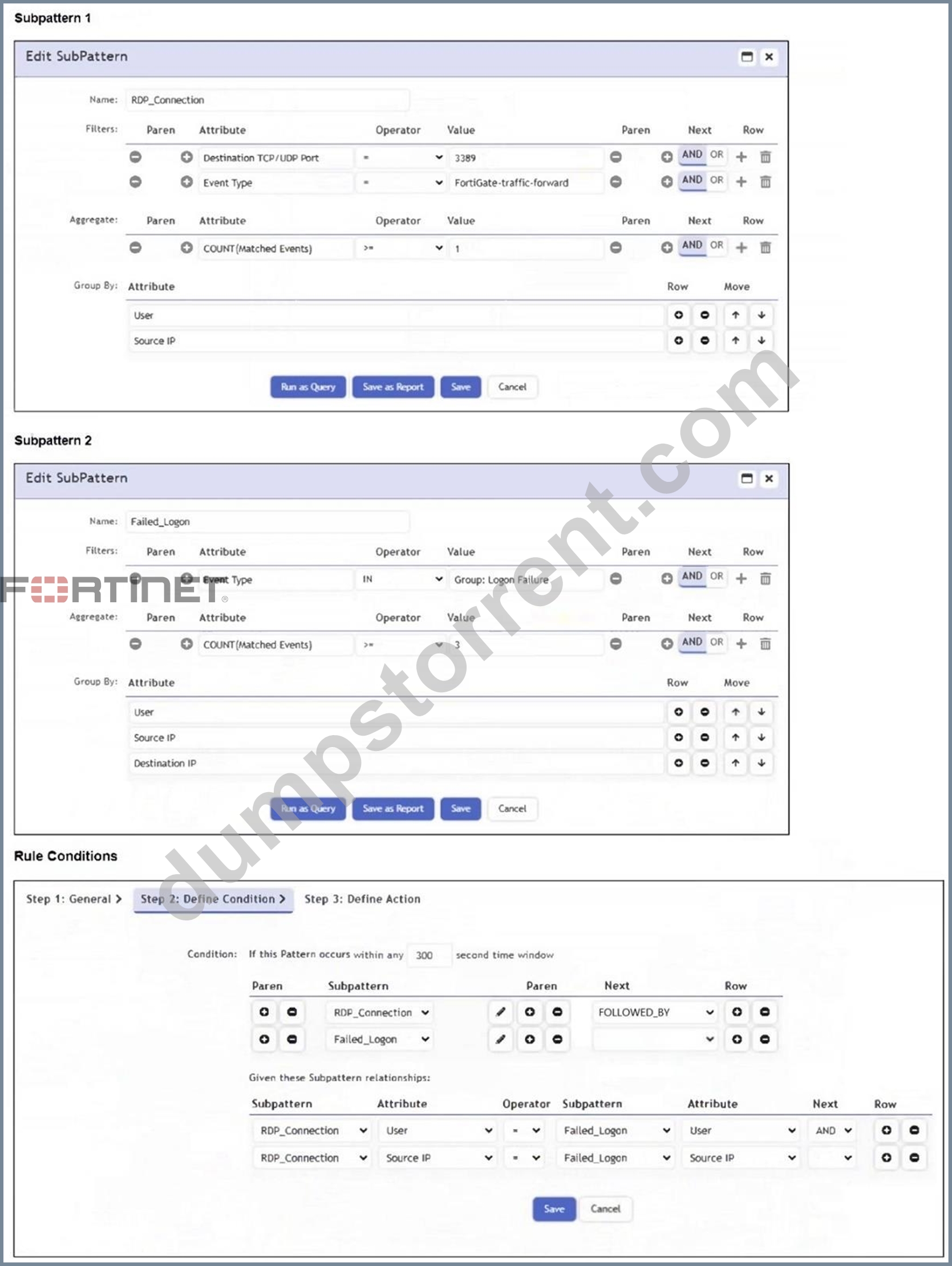
Which two conditions will match this rule and subpatterns? (Choose two.)
- A. A user connects to the wrong IP address for an RDP session five times.
- B. A user using RDP over SSL VPN fails to log in to an application five times.
- C. A user runs a brute force password cracker against an RDP server.
- D. A user fails twice to log in when connecting through RDP.
Answer: B,C
Explanation:
The user initiates an RDP session (Subpattern 1) and then fails to log in multiple times (Subpattern 2 with COUNT(Matched Events) >= 3) - both from the same Source IP and User within 300 seconds.
The brute force attempts typically involve a successful RDP connection followed by multiple failed logins, satisfying the sequence and grouping conditions in the rule.
NEW QUESTION # 32
Refer to the exhibit.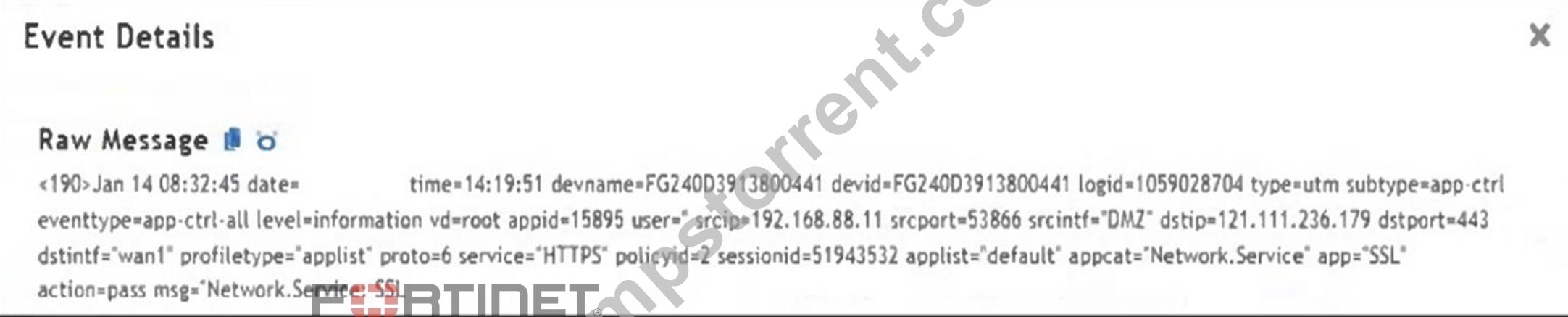
Which value would you expect the FortiSIEM parser to use to populate the Application Name field?
- A. wan1
- B. Network.Service
- C. applist
- D. SSL
Answer: D
Explanation:
The Application Name field in FortiSIEM is typically populated using the value of the app field in the raw log. In this event, app="SSL", so "SSL" is the expected application name parsed by FortiSIEM.
NEW QUESTION # 33
Refer to the exhibit.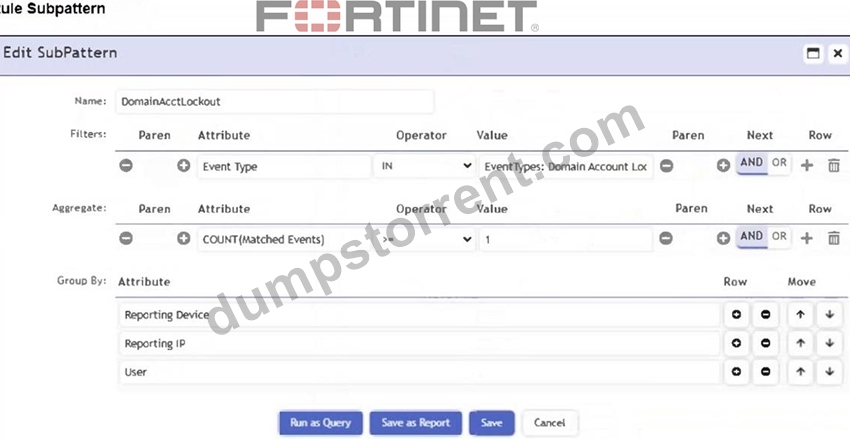
Which section contains the subpattern configuration that determines how many matching events are needed to trigger the rule?
- A. Aggregate
- B. Actions
- C. Group By
- D. Filters
Answer: A
Explanation:
The Aggregate section contains the condition COUNT(Matched Events) >= 1, which defines how many events must match the filter criteria for the rule to trigger. This is the subpattern configuration that determines the event threshold.
NEW QUESTION # 34
Refer to the exhibit.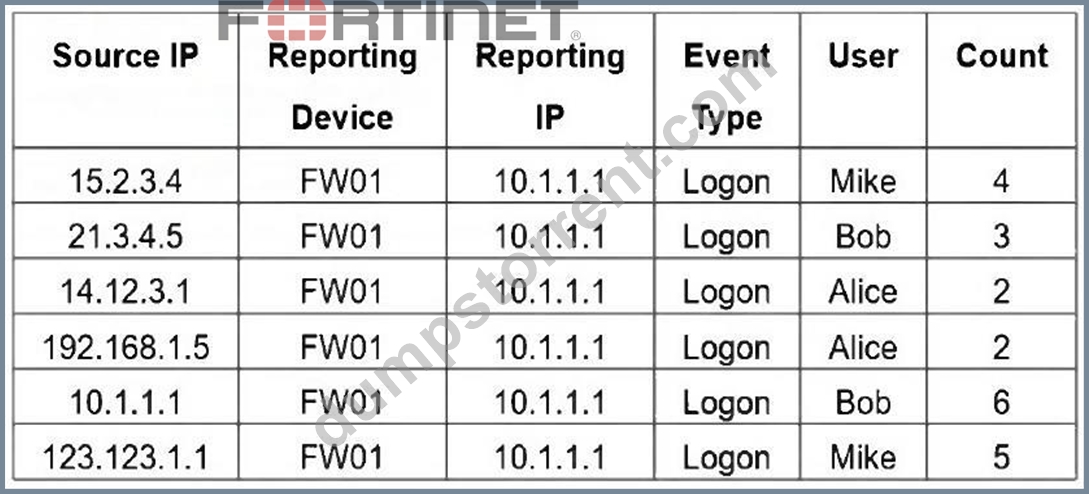
If you group the events by User and Count attributes, how many results will FortiSIEM display?
- A. Five
- B. Two
- C. One
- D. Three
- E. Six
Answer: A
Explanation:
Grouping by User and Count yields five unique pairs: (Mike,4), (Bob,3), (Alice,2), (Bob,6), (Mike,5).
NEW QUESTION # 35
Where can an analyst configure rule notifications and automated remediation on FortiSIEM?
- A. Notification policy
- B. Response policies
- C. Notification engine
- D. Automation policy
Answer: D
NEW QUESTION # 36
......
Pass Your FCP_FSM_AN-7.2 Exam Easily With 100% Exam Passing Guarantee: https://pass4sure.dumpstorrent.com/FCP_FSM_AN-7.2-exam-prep.html