

Pass Exam Questions Efficiently With JN0-224 Questions (2026)
JN0-224 Questions - Truly Beneficial For Your Juniper Exam
Juniper JN0-224 Exam Syllabus Topics:
| Topic | Details |
|---|---|
| Topic 1 |
|
| Topic 2 |
|
| Topic 3 |
|
| Topic 4 |
|
| Topic 5 |
|
NEW QUESTION # 32
What will determine which data serialization format is used for interfacing with a system?
- A. the system's API
- B. IDE specifications
- C. programming language version
- D. the operating system
Answer: A
NEW QUESTION # 33
You are using the curl tool to include multiple RPCs in a REST API request.
Which HTTP method must be used for this request?
- A. GET
- B. PUT
- C. POST
- D. HEAD
Answer: C
NEW QUESTION # 34
Which two PyEZ object methods are included by default when using a Python context manager? (Choose two.)
- A. lock () and unlock (>
- B. open() and close()
- C. |load() and commit ()
- D. pdiff() and diff()
Answer: A,B
Explanation:
When using a Python context manager with Junos PyEZ, two key methods are automatically included:
open() and close(): These methods are used to establish and terminate a connection to a Junos device. When you use a context manager (the with statement), open() is called when entering the block, and close() is called when exiting, ensuring the connection is properly managed.
lock() and unlock(): These methods are used to lock the configuration database to prevent other users from making changes while you are working on it. When using a context manager, lock() is called at the start of the block, and unlock() is called at the end, ensuring safe configuration changes.
Supporting Reference:
Junos PyEZ Documentation: The documentation explains how context managers work in PyEZ, including the automatic invocation of open(), close(), lock(), and unlock() methods.
NEW QUESTION # 35
Exhibit.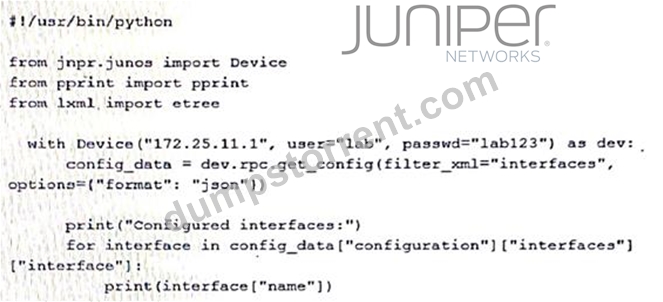
Referring to the exhibit, which two statements about the script are correct? (Choose two.)
- A. The script prints the name of each configured interface.
- B. The script retrieves the interface configuration in JSON.
- C. The script prints interface information for each interface name.
- D. The script retrieves the interface configuration in XML
Answer: A,B
NEW QUESTION # 36
Which two data structures are used in JSON? (Choose two.)
- A. tuples
- B. objects
- C. arrays
- D. dictionaries
Answer: B,C
Explanation:
In JSON (JavaScript Object Notation), the two primary data structures are:
Objects: These are collections of key-value pairs, where each key is a string, and the value can be a string, number, array, boolean, or another object. In Python, this structure is analogous to a dictionary.
Arrays: These are ordered lists of values, where each value can be of any data type, including another array or object. In Python, this structure is similar to a list.
Option A (tuples) and Option D (dictionaries) refer to Python-specific data structures and are not directly used in JSON.
Supporting Reference:
JSON Documentation and Tutorials: JSON objects and arrays are the standard data structures used in this format, as described in many tutorials and the official JSON documentation.
NEW QUESTION # 37
Exhibit.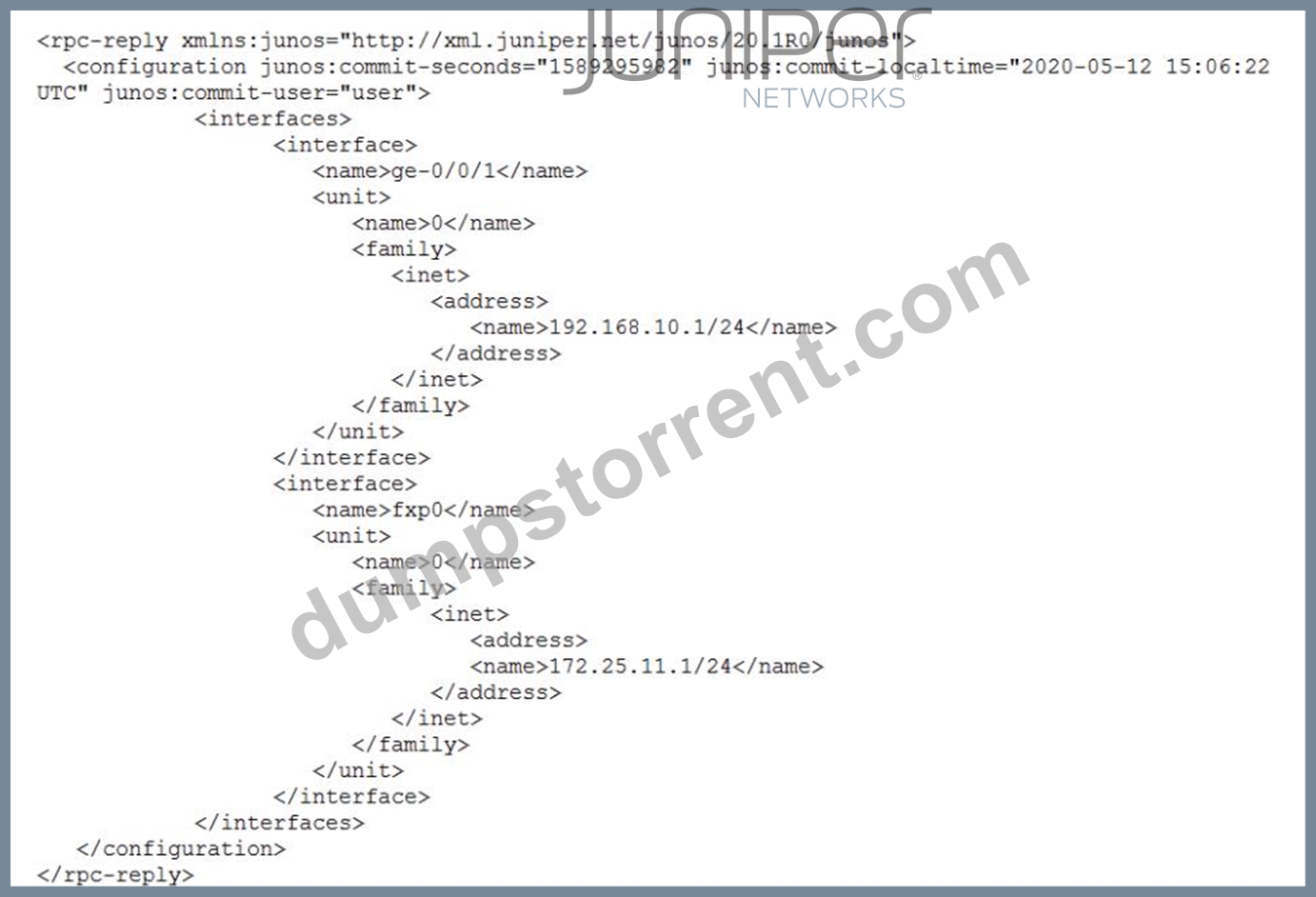
Referring to the exhibit, which XML XPath expression will only show the IP address XML elements?
- A. //address/name
- B. //name
- C. /name
- D. /address/name
Answer: A
Explanation:
https://www.w3schools.com/xml/xpath_syntax.asp
NEW QUESTION # 38
Which two statements about XML schema definition (XSD) files are correct? (Choose two.)
- A. XSD files define all the elements in an XML document and the document XML hierarchy.
- B. XSD files ensure that everyone working with the XML document uses a common set of tags.
- C. Every XML document must have an XSD file defined for it.
- D. An XSD file is not an XML document.
Answer: A,B
Explanation:
XML Schema Definition (XSD) files are used to define the structure and data types of an XML document. They ensure that the XML document adheres to a specific structure by defining the allowed elements, attributes, and their data types, thereby enforcing a consistent format.
Option A is correct because XSD files define the elements, attributes, and structure (hierarchy) of an XML document.
Option D is correct because XSD files provide a standardized format, ensuring that all parties working with the XML document use the same set of tags and structure.
Option B (Every XML document must have an XSD file defined for it) is incorrect; not every XML document requires an XSD file, although it's beneficial for validation.
Option C (An XSD file is not an XML document) is incorrect because XSD files themselves are written in XML.
Supporting Reference:
W3C XML Schema Definition (XSD) Documentation: Explains the purpose and structure of XSD files, including their role in defining XML document schemas.
NEW QUESTION # 39
Which statement about the NETCONF content layer is true?
- A. It uses XML for RPC request and response payloads.
- B. It uses YAML for RPC request and response payloads.
- C. It uses JSON for RPC request and response payloads.
- D. It uses HTML for RPC request and response payloads.
Answer: A
Explanation:
The NETCONF protocol, used for network management, utilizes XML for encoding the RPC (Remote Procedure Call) requests and responses. XML is chosen because of its flexibility and ability to represent hierarchical data structures, making it well-suited for representing network configurations and states.
Option B is correct because XML is the standard format used for NETCONF RPC payloads.
Options A (YAML), C (JSON), and D (HTML) are incorrect because these formats are not used by NETCONF for its RPC payloads.
Supporting Reference:
RFC 6241 - NETCONF Protocol: This RFC describes the use of XML for encoding NETCONF messages.
NEW QUESTION # 40
Which development model is the classic approach to software development?
- A. Lean
- B. Kanban
- C. Scrum
- D. Waterfall
Answer: D
NEW QUESTION # 41
Your organization is developing an application to automate management of Junos network appliances. You want to use the existing PyEZ libraries to improve the development process. Which API would satisfy this requirement?
- A. JETAPI
- B. RPC API
- C. REST API
- D. XML API
Answer: C
NEW QUESTION # 42
Which Junos configuration database is updated by PyEZ by default?
- A. dynamic
- B. ephemeral
- C. private
- D. shared
Answer: C
Explanation:
An event script is used to automate responses to system events in Junos, such as an interface going down. These scripts are triggered automatically when a specified event occurs, making them suitable for tasks like monitoring interface status and executing actions when the status changes.
Option B (event) is correct because event scripts are designed for reacting to system events like an interface going down.
Option A (commit) is used for configuration changes, Option C (operation) is used for operational tasks, and Option D (SNMP) is not applicable in this context.
Supporting Reference:
Juniper Networks Event Scripts Documentation: Details how event scripts are used to automate responses to specific system events in Junos
NEW QUESTION # 43
A REST API client uses which two HTTP methods to execute RPC requests on the server? (Choose two.)
- A. GET
- B. CONNECT
- C. POST
- D. HEAD
Answer: A,C
Explanation:
REST APIs use HTTP methods to perform different operations on resources. In the context of RPC (Remote Procedure Call) requests:
GET: This method is used to retrieve data from the server. In a REST API, it is commonly used to fetch information about resources, such as the current configuration or operational state.
POST: This method is used to send data to the server to create or update a resource. In the context of RPC, POST is often used to execute a procedure on the server that may result in the modification of a resource or triggering of an action.
Options B (HEAD) and D (CONNECT) are not typically used for executing RPC requests:
HEAD is similar to GET but only retrieves the headers, not the body of the response.
CONNECT is used to establish a tunnel to the server, primarily for SSL-encrypted communication, and is not commonly associated with RESTful RPC operations.
Supporting Reference:
Juniper Networks REST API Documentation: The documentation provides detailed information about the use of HTTP methods in Juniper's RESTful services.
"RESTful Web Services" by Leonard Richardson and Sam Ruby: This book explains the principles of REST and how different HTTP methods, particularly GET and POST, are used to interact with RESTful APIs.
NEW QUESTION # 44
Which two statements about Junos automation are correct? (Choose two.)
- A. The Junos REST API client is off-box.
- B. The Junos REST API client is on-box.
- C. Junos automation does not allow for device provisioning throuqh the console port.
- D. Junos automation allows for device provisioning through the console port.
Answer: B,D
NEW QUESTION # 45
You are asked to use the REST API to retrieve interface configuration information from your Junos device. You decide to use a cURL HTTP GET command to retrieve this information.
In this scenario, which statement is correct?
- A. The request is handled by the mod process running on the Junos device.
- B. The request is handled by the isrpd process running on the Junos device.
- C. The request is handled by the isd process running on the Junos device
- D. The request is handled by the rpd process running on the Junos device.
Answer: B
Explanation:
When using the REST API on a Junos device, the isrpd (Integrated Service Routing Process Daemon) process is responsible for handling REST API requests. This process listens for incoming HTTP requests and processes them accordingly, including retrieving interface configuration information when a GET request is made.
Option B is correct because the isrpd process handles the REST API requests on a Junos device.
Options A (mod process), C (rpd process), and D (isd process) are incorrect in this context as they either do not exist or serve different purposes on a Junos device.
Supporting Reference:
Juniper Networks REST API Documentation: Provides insights into how REST API requests are managed and processed by the isrpd process on Junos devices.
NEW QUESTION # 46
Which statement about the NETCONF content layer is true?
- A. It uses XML for RPC request and response payloads.
- B. It uses YAML for RPC request and response payloads.
- C. It uses JSON for RPC request and response payloads.
- D. It uses HTML for RPC request and response payloads.
Answer: A
NEW QUESTION # 47
Which two statements about Ansible are correct? (Choose two.)
- A. Ansible can use a single playbook to configure devices from multiple vendors.
- B. Ansible requires a license to unlock full functionality.
- C. Ansible is an open source project.
- D. Ansible modules must be written in Go.
Answer: A,C
NEW QUESTION # 48
Which two statements about NETCONF are correct? (Choose two.)
- A. The default port for NETCONF is port 930.
- B. The default port for NETCONF is port 830.
- C. NETCONF can use the default SSH port.
- D. NETCONF cannot use the default SSH port.
Answer: B,C
Explanation:
NETCONF (Network Configuration Protocol) is used for network device management and can operate over SSH. The following are true about NETCONF:
Default Port 830 (B): By default, NETCONF uses port 830 for communication over SSH. This is the standard port reserved for NETCONF sessions.
Use of Default SSH Port (D): NETCONF can also operate over the standard SSH port (port 22) if configured to do so. This allows flexibility in network management scenarios where port 830 might not be available or used.
Options A and C are incorrect because they refer to incorrect or non-applicable port numbers for NETCONF.
Reference:
IETF RFC 6241: Specifies the use of NETCONF over SSH, including port details.
Juniper Networks NETCONF Documentation: Discusses the configuration and operation of NETCONF on Junos devices, including port usage.
NEW QUESTION # 49
What is the default port for NETCONF connections over SSH?
- A. 0
- B. 1
- C. 2
- D. 3
Answer: A
Explanation:
https://www.juniper.net/documentation/us/en/software/junos/netconf/topics/topic-map/netconf-ssh-connection.html The IANA-assigned port for NETCONF-over-SSH sessions is 830.
NEW QUESTION # 50
Which two statements about NETCONF are true? (Choose two.)
- A. It uses the operations layer to commit the configuration of a Junos device.
- B. It uses the messages layer to lock the configuration of a Junos device.
- C. It uses the messages layer to commit the configuration of a Junos device.
- D. It uses the operations layer to lock the configuration of a Junos device.
Answer: A,D
Explanation:
NETCONF (Network Configuration Protocol) operates through different layers, with the operations layer being particularly important for managing configurations:
Operations Layer (A & D): This layer is responsible for actions like locking and committing the configuration on a Junos device. The lock operation prevents other sessions from modifying the configuration, and the commit operation applies the configuration changes to the device.
Options B and C are incorrect because the messages layer handles the communication aspects, such as exchanging data between the client and server, not performing configuration operations like locking and committing.
Reference:
IETF RFC 6241 (NETCONF): Describes the protocol layers and their functions, with a focus on the operations layer.
Juniper Networks NETCONF Documentation: Provides insights into how NETCONF operations are managed in Junos
NEW QUESTION # 51
Which two standard logical operators does XPath support? (Choose two.)
- A. AND
- B. IOR
- C. NOT
- D. MAMD
Answer: A,C
Explanation:
XPath is a query language used for selecting nodes from an XML document. It supports various logical operators that can be used to create complex queries. The two standard logical operators supported by XPath are:
NOT: This operator negates a condition, returning true if the condition is false, and vice versa.
AND: This operator is used to combine two conditions, and it returns true only if both conditions are true.
Option A (IOR) and Option D (MAMD) are not standard XPath operators.
Supporting Reference:
XPath Documentation: The W3C XPath specification lists the standard operators supported in XPath, including AND and NOT.
NEW QUESTION # 52
You are asked to write an on-box script that will be triggered when a specific interface on a Junos device goes down.
Which type of on-box script should you use to accomplish this task?
- A. event
- B. commit
- C. SNMP
- D. operation
Answer: A
Explanation:
An event script is used to automate responses to system events in Junos, such as an interface going down. These scripts are triggered automatically when a specified event occurs, making them suitable for tasks like monitoring interface status and executing actions when the status changes.
Option B (event) is correct because event scripts are designed for reacting to system events like an interface going down.
Option A (commit) is used for configuration changes, Option C (operation) is used for operational tasks, and Option D (SNMP) is not applicable in this context.
Supporting Reference:
Juniper Networks Event Scripts Documentation: Details how event scripts are used to automate responses to specific system events in Junos
NEW QUESTION # 53
Which two statements are correct about the Junos REST API Explorer? (Choose two.)
- A. The REST API Explorer supports both GET and POST calls.
- B. The REST API Explorer returns data only in XML format.
- C. The REST API Explorer is enabled by default on all Junos devices.
- D. The REST API Explorer supports multiple RPC calls.
Answer: A,D
Explanation:
The Junos REST API Explorer provides an interactive environment to explore and execute REST API calls. The correct statements are:
Supports GET and POST Calls (C): The REST API Explorer allows users to make both GET and POST requests, enabling retrieval and submission of data to the Junos device.
Supports Multiple RPC Calls (D): The REST API Explorer can execute multiple RPC (Remote Procedure Call) commands, allowing a wide range of operations to be performed directly through the interface.
Option A is incorrect because the REST API Explorer is not enabled by default; it must be enabled manually. Option B is incorrect because the REST API Explorer returns data in both XML and JSON formats, not just XML.
Reference:
Junos REST API Explorer Documentation: Provides details on the supported operations and how to use the Explorer for different types of requests.
Juniper Networks Documentation: Covers the setup and usage of the REST API Explorer.
NEW QUESTION # 54
Which two statements about Junos automation are correct? (Choose two.)
- A. The Junos REST API client is off-box.
- B. The Junos REST API client is on-box.
- C. Junos automation does not allow for device provisioning throuqh the console port.
- D. Junos automation allows for device provisioning through the console port.
Answer: B,D
Explanation:
A). The Junos REST API client is on-box:
The Junos REST API is on-box, meaning it is hosted directly on the Junos OS device. This allows you to interact with the device through RESTful API calls without needing an external client to act as an intermediary. With the on-box REST API, users can manage and automate configuration and operational tasks directly from the Junos device itself using HTTP/HTTPS protocols. This simplifies automation and remote management since the API server is embedded within the device.
Key Automation Capabilities of On-box REST API:
Supports configuration, monitoring, and operational commands.
Allows for direct device interaction via tools like curl, or through custom-built automation scripts.
Reference:
C . Junos automation allows for device provisioning through the console port:
Junos automation does indeed allow for device provisioning through the console port, especially in the context of Zero Touch Provisioning (ZTP). When network interfaces are not initially configured, or when remote access is not possible, devices can be provisioned via the console port. This method is commonly used during the initial setup process, enabling administrators to deploy configurations even without network access. ZTP automates initial configurations, including system setup and software installation, which can be triggered via the console.
Key Advantages of Console-based Provisioning:
Useful in environments where network interfaces are unavailable or not yet configured.
Essential for the initial bootstrapping of devices in remote locations.
Why the Other Options Are Incorrect:
B . Junos automation does not allow for device provisioning through the console port: This statement is incorrect because Junos automation does allow for provisioning via the console port, particularly during initial device setups.
D . The Junos REST API client is off-box: This is incorrect because the REST API client can be directly on the Junos device, providing local API functionality (on-box).
Juniper Automation in DevOps Context: Junos automation, especially with on-box REST API and console-based provisioning, enhances the flexibility and accessibility of device management in DevOps environments. These capabilities simplify remote configuration, monitoring, and device setup even in cases where direct network access is unavailable.
NEW QUESTION # 55
You want to use a Python package or module.
In this scenario, which statement would accomplish this task?
- A. dir
- B. reap
- C. input
- D. Import
Answer: D
Explanation:
In Python, to use a package or module, you use the import statement. This statement allows you to load a module into your script so that you can use its functions, classes, and variables. For example, if you wanted to use the math module, you would write import math. This makes all the functions and constants in the math module available for use in your program.
Option A (reap), B (dir), and C (input) do not serve the purpose of importing modules. dir is used to list the attributes of an object, input is used to get user input, and reap is not a valid Python command related to importing modules.
Supporting Reference:
Python Documentation on Imports: The Python documentation provides clear guidelines on how to use the import statement to include modules in your Python scripts.
NEW QUESTION # 56
What is an example of correct XML syntax?
- A. <Devices><hostname>vMX1<De vices/X/hostname>
- B. <Devices><hostname>vMX1</ho3tnameX/Device3>
- C. <Device3><ho3tname>vMX1</hostname><Devices/>
- D. <Devices><hostname>vMX1<Devices/>
Answer: A
NEW QUESTION # 57
......
Truly Beneficial For Your Juniper Exam: https://pass4sure.dumpstorrent.com/JN0-224-exam-prep.html